
More Streams, Less Money: Why Music Does not Pay Well in Nigeria
by
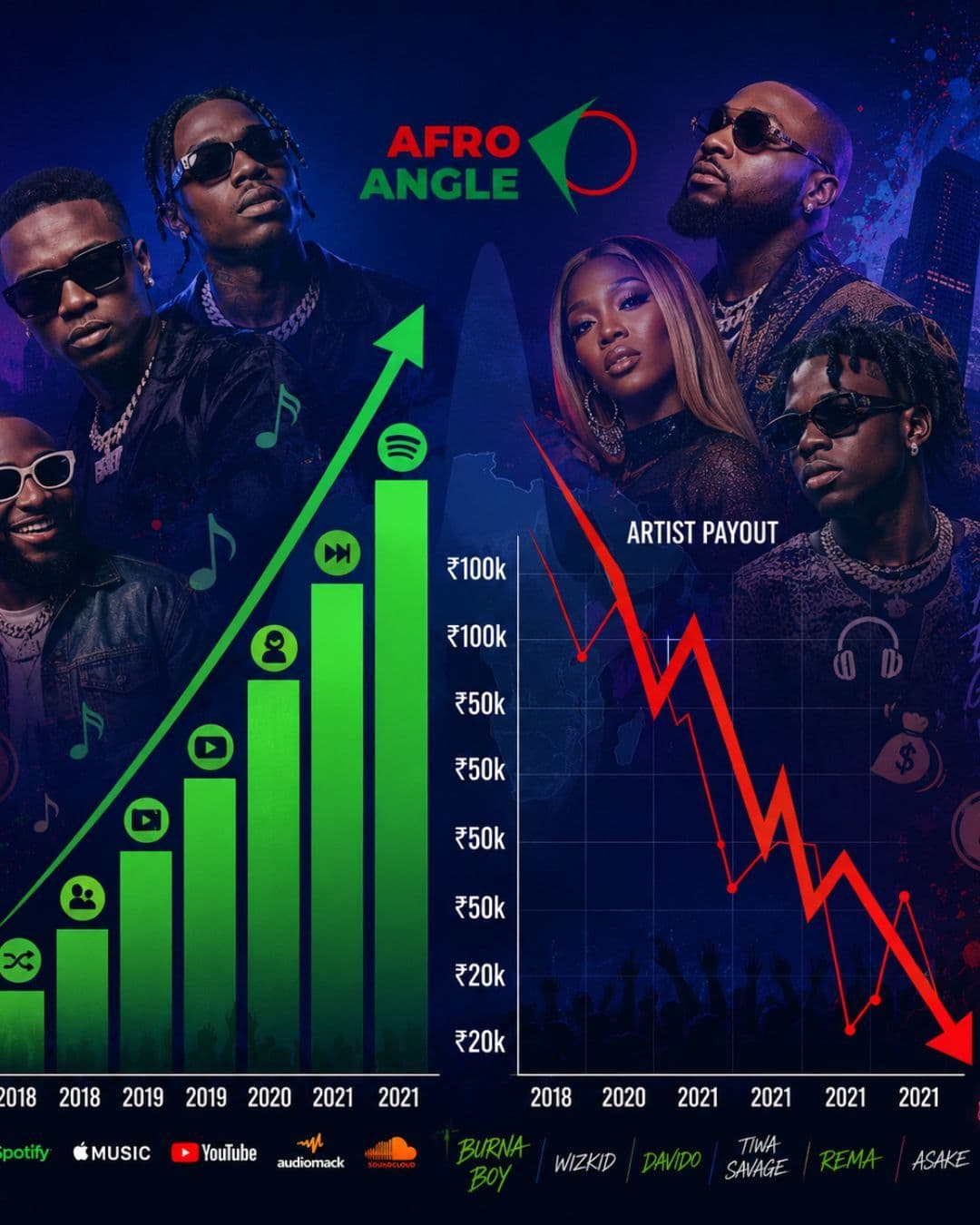
For Nigerian artists, local streams are climbing, which signals that more Nigerians are turning to digital streaming platforms for their day-to-day music consumption. A decade ago, music distribution looked different. Piracy sites ruled, and they charged artists to host their work, or paid them nothing at all. Now Spotify, Apple Music, and Boomplay have reshaped how Nigerians consume music. This shift represents a real win for the Nigerian music industry.
Spotify’s 2025 Loud & Clear report, released in March 2026, showed a surge in streams for Nigerian music. At first glance, this seems positive, but the reality is more complicated when you learn that the average payout per stream has actually dropped. Growth in domestic streaming has reduced the per-stream value that artists receive. For a regular listener, climbing stream numbers spell success, but for an Afrobeats artist, millions of plays do not necessarily mean enough money to cover the next studio session.
Despite this rise in stream number, the distribution of earning has been significantly disproportional. In 2025, Nigerian artists racked up to 30.3 billion streams and 1.6 billion listening hours on Spotify. Impressive figures on their own. Yet according to that same report, Nigerian musicians pocketed roughly 2 Naira per stream on average. For instance, a million streams in Nigeria generated about $300. In the United States, that same million streams pulled in $4,000 or more—thirteen times as much—and similar outcome is obtainable in other high-income countries.
So what are the influencing factors behind this? The answer comes down to basic economics: disposable income. According to the 2025 Risevest Cost of Living Report, Nigerian households spend an average of 15,321 Naira monthly on entertainment. But that money covers everything from cinema tickets to nightclub entry, cable subscriptions, and live concerts. Music streaming gets only a fraction of that pie. Nobody has the exact figures on how many Nigerians actually pay for streaming, but the real number is probably lower. Most users stick with the free option of Spotify or YouTube Music, which generate minimal ad revenue for the platforms.
A streaming service pays out from a single pool of money that comes from subscriptions and advertisements. If users in a country pay very little, the pool stays small. At a prevailing Central Bank of Nigeria exchange rate of ₦1,356.27 per US Dollar, premium music subscriptions are heavily subsidized to match local purchasing power. A standard Spotify Premium Individual plan in Nigeria costs ₦1,600 per month, which converts to approximately $1.18, while the same plan in the US costs $11.99. Apple Music follows a similar pattern: ₦1,300 per month in Nigeria ($0.96) versus £10.99 in the UK. Student and family options drop even lower—Spotify Student at ₦800 ($0.59) and Apple Music Student at ₦650 ($0.48)—while family plans peak between ₦2,000 ($1.47) and ₦2,500 ($1.84). Nigerian advertisers do not outpay foreign advertisers either. So whether the platforms rely on subscription or advertisements, as long as a Nigerian artist only has mostly local listeners, the payout per stream remains low.
Find the Light at the End of Afrobeats Tunnel
Over the last ten years, many Nigerian musicians have attempted to work around this problem by pitching their music to the western world. Each of them has taken a different approach, with results that vary widely. The goal remains consistent: earn in dollars and pounds while maintaining a Nigerian fanbase. But chasing two audiences simultaneously proves harder than it appears.
In 2017, Wizkid released his third studio album, Sounds From The Other Side, which featured cross-continental collaborations with Drake, Chris Brown, Ty Dolla $ign, Major Lazer, and Trey Songz. For Wizkid, the album marked a deliberate shift towards R&B, pop, and Caribbean influences; however it never quite achieved the commercial breakthrough many expected. For him, the calculation was straightforward: strengthen his foothold in the western market following the global success of One Dance. Other artists have pursued similar strategies, enlisting foreign labels and managers to crack western markets, but only got mixed outcomes.
But the real target for African musicians extends beyond America or Europe. The African Diaspora and Black communities outside the continent represent the true opportunity. These audiences connect naturally with African music in ways others don’t. A Nigerian artist performing in London will draw British Nigerians, while another playing in Houston attracts Nigerian-Americans and Ghanaian-Americans. These crowds already love the culture and possess considerably more disposable income than listeners back home, which means they spend money on concert tickets, merchandise, and even digital albums. For African artists, this represents a lifeline. Rising acts regularly court the diaspora by performing in cities with substantial African populations like London, New York, and Atlanta, collaborating with Black musicians, and adopting Black American aesthetics.
Killing Two Birds With A Stone?
This approach comes with two major setbacks. First, it creates a dilemma in the creative and marketing strategies of musicians and their labels. Should an artist make a song for the Nigerian market or for a British Nigerian crowd? Should the video look like Lagos or like East London? These choices matter. The Nigerian market has a different taste from the American market. Nigerian listeners love street slang and local references while diaspora listeners want connection but also a touch of their own environment. Sometimes, attempting to kill two birds with a stone leads to music projects not fulfilling their prospects both creatively and commercially.
Second, the focus on foreign audiences leaves the local market underserved. An artist may hold a show in Lagos and then tour Europe for three months, making local fans feel abandoned. The sad truth is that one cannot serve two masters at the same time. Satisfying both Lagos and London with the same song, or the same visual aesthetics may be challenging. The neglect of the local market shows with artists putting more energy into foreign tours while holding only one or two shows in Nigeria. Local live performances get less attention and fan engagement generally becomes low.
This pattern will not change until streaming income at home becomes fairer. That will only happen when more Nigerians pay more for streaming services. And more Nigerians will only pay when their disposable income rises. With streaming contributing 69.6% of music revenue according to the International Association of the Phonographic Industry, streaming becoming more lucrative is the first challenge for the further commercialisation of African music. This puts a burden on the government: to improve economic conditions so that domestic listeners will pay more than they currently do and domestic tickets, more valuable than they currently are. Until then, Afrobeats will remain a strange success story. The world will dance to the music but the people who make it will keep looking for a better market overseas.
Samuel Omofala
Samuel Omofala is a journalist, law student, and award-winning essayist with a strong focus on entertainment, culture, and the economy. In 2025, he won the 7th edition of the prestigious Fisayo Soyombo Inter-varsity Essay Contest, beating over one hundred other entries. His contributions to campus journalism at the University of Ibadan have earned him significant recognition, including Most Energetic Campus Journalist (Administrative), a nomination for Most Promising Campus Journalist, and leadership of a local press organisation.
comments
No comments yet