
Armed incursions persist across the North-West, as Military Pressure expands on militant groups.
by

North-west Nigeria: Security Situation Report (April 26 - May 2, 2026)
Introduction:
Between April 26 and May 2, the Nigerian military conducted a series of coordinated airstrikes, supported by ground assaults, targeting insurgent strongholds in Faskari Local Government Area (LGA) of Katsina State. According to Battle Damage Assessments, the operations neutralised several fighters and destroyed a key logistics hub used to coordinate attacks across the Faskari, Funtua, and Kankara axes, dealing a significant blow to the groups’ short-term operational capacity.
However, these battlefield gains have yet to translate into sustained security for rural populations. Communities across the region continue to endure repeated raids, mass abductions, and targeted violence, particularly against women and children. In many cases, these attacks are accompanied by widespread looting, cattle rustling, and assaults along critical transit corridors, reinforcing the sense of insecurity surrounding both livelihoods and mobility.
A particularly significant development during the reporting period was the alleged withdrawal of security personnel from a military base in Lilo village, located in Gusau Local Government Area of Zamfara state. The presence of troops in the area had previously served as a key deterrent against armed attacks. Their withdrawal, however, reportedly triggered the displacement of residents from nearly 30 surrounding communities, as fears of renewed incursions intensified. This movement of displaced populations toward urban centres is raising growing humanitarian concerns, particularly in the state capital, where existing pressures on shelter, food access, and public services are already severe.
Reports linking the withdrawal to the onset of the rainy season also highlight a broader operational vulnerability across the North-west. Poor road infrastructure and difficult terrain often limit military mobility during the rainy months, slowing reinforcement efforts and constraining rapid response capabilities in high-risk areas. As seasonal conditions worsen, both civilian communities and military formations are likely to become more vulnerable to ambushes and mobility-based attacks.
This transition into the rainy season, therefore, represents more than a climatic challenge; it is a tactical shift that could reshape the operational environment across multiple theatres. Within this evolving landscape, sustained pressure on the Lakurawa group and other armed factions will remain critical in determining whether current military gains can be maintained or whether insurgent groups will exploit seasonal vulnerabilities to regain momentum.
Week in Review
A comparative analysis of this reporting period against the previous week indicates a moderate increase across all major security indicators in the North-west. Recorded incidents rose from 15 to 18, representing a 20% increase in the operational tempo of attacks on civilian communities. Abductions also increased from 28 to 38, marking a 36% rise in kidnapping activities targeting both rural residents and commuters along major highways. Fatalities followed a similar trend, climbing from 24 to 32, a 33% increase from the previous week. The upward movement across all tracked metrics points to a continued deterioration in the region’s security environment.
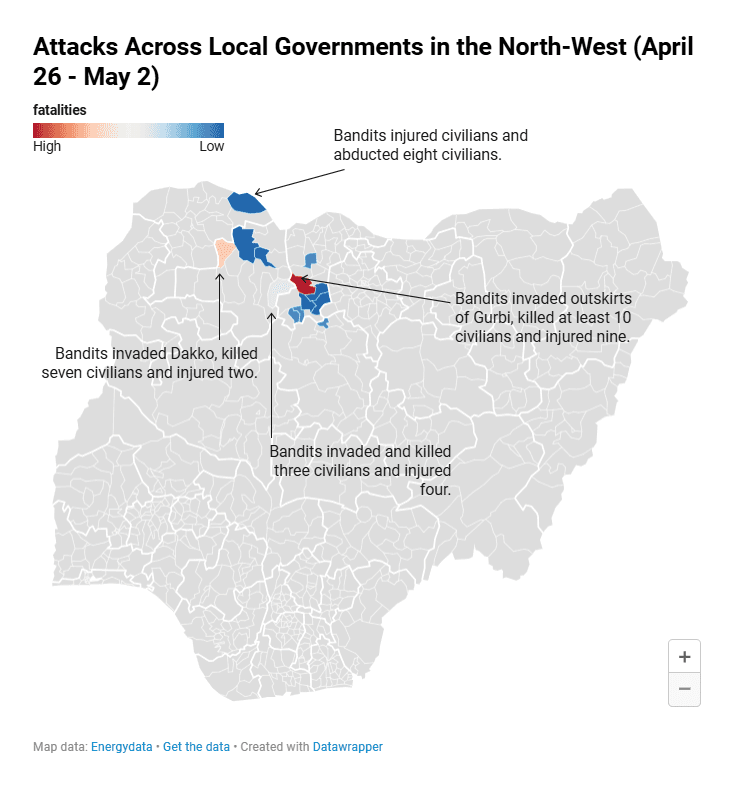
Geographically, violence remained concentrated in Zamfara and Katsina states, which continue to serve as the epicenters of armed group activity in the North-west. Zamfara recorded the highest number of fatalities, with 17 deaths, while Katsina accounted for the highest levels of both attacks and abductions, recording 9 incidents and 15 kidnappings, respectively. This distribution highlights the sustained pressure across the region’s core insecurity corridors, where armed groups continue to operate with significant mobility and reach.
Analysis: Military Pressure Mounts on Lakurawa and other armed groups
The Lakurawa group has come under increasing operational pressure across its core areas of influence, driven in part by intensified collaboration between the military and local vigilante networks. Recent operations indicate a growing shift toward community-supported counterinsurgency efforts aimed at disrupting the group’s movement and weakening its local infrastructure.
In one notable incident, vigilantes from Sago in Kebbe Local Government Area of Sokoto State reportedly ambushed a Lakurawa convoy led by the group’s North-west deputy commander, Tijani Al-Bashir. Two militants were killed in the attack, although Al-Bashir reportedly escaped. In a separate operation in Gada Local Government Area, military personnel supported by vigilante groups killed seven Lakurawa fighters who were allegedly preparing coordinated attacks on nearby villages.
These developments underscore the growing importance of vigilante networks in sustaining pressure on Lakurawa and complementing formal military operations. Since the group’s emergence across parts of Sokoto, Kebbi, and Niger states, vigilante groups have served as the immediate line of community defence, often providing early warning, local intelligence, and rapid response capabilities in areas where military presence remains limited.
At the same time, the recent setbacks suffered by Lakurawa raise the likelihood of retaliatory attacks against communities perceived to be cooperating with security forces. This risk is particularly concerning as the rainy season approaches, a period that historically constrains military mobility, slows reinforcement efforts, and reduces rapid-response capacity in remote areas due to poor road conditions.
There are also increasing concerns that as Lakurawa expands deeper into isolated rural areas, more farming communities may be subjected to illegal taxation and coercive levies during the agricultural season. Such tactics not only strengthen the group’s financing networks but also deepen its control over local economic life and civilian populations.
Outlook
In the coming weeks, armed group activity across the North-west is expected to persist, with continued attacks targeting civilian communities, transport corridors, and local infrastructure. The humanitarian situation is also likely to worsen as more residents flee vulnerable rural areas for urban centres and relatively secured locations, particularly as security forces reduce their footprint in difficult-to-access areas ahead of the peak rainy season.
The Nigerian military is expected to sustain ongoing offensive operations, although worsening terrain conditions may increasingly limit the effectiveness of ground manoeuvres. As a result, air operations will likely play a more central role in supporting counter-terrorism efforts and maintaining operational pressure on armed groups.
There are growing fears that Lakurawa could intensify retaliatory attacks against communities suspected of collaborating with state security forces, mirroring patterns previously observed in parts of Arewa Dandi in Kebbi State. This raises the urgent need for strengthened community protection mechanisms and more structured support for vigilante groups operating in frontline areas.
The coming weeks will therefore be critical. Armed groups are likely to exploit the rainy season to expand mobility and operational concealment, while conventional security forces face increasing logistical constraints. Managing this evolving threat environment will require a combination of reinforced community defence structures, improved battlefield intelligence, and sustained precision-led air operations aimed at disrupting insurgent movement and logistics before they can consolidate further influence.
Afroangle Intel Admin
Northwest Nigeria Report Admin
comments
No comments yet