
Highway Vulnerability and the Evolving Political-Security Landscape in Northwest Nigeria
by
Listen to this article
Northwest Nigeria: Security Situation Report (March 29 – April 3, 2026)
Introduction
The security architecture across Northwest Nigeria is currently undergoing a profound and troubling transformation. While rural communities have long endured the predations of armed groups, the reporting period of March 28 to April 3, 2026, revealed a sharp escalation in both the scale and the strategic focus of these attacks.
This deterioration occurs against a backdrop of two potentially major shifts in the regional landscape: a major leadership vacuum within the insurgent group Lakurawa and the premature onset of the 2027 political cycle. During this window, the region is facing an unrelenting barrage of coordinated assaults on agricultural hubs, large-scale abductions on federal highways, and direct kinetic confrontations with state security forces. While Lakurawa appeared to maintain a lower operational profile, likely recovering from internal command disruption, the vacuum was aggressively filled by a plethora of highly mobile bandit factions, whose activities have now reached a high pitch of lethality and economic disruption.
The reporting week introduced a new, fragile dynamic. The alleged elimination of Lakurawa’s Northwest regional commander in Kebbi State threatens to fracture the group’s command-and-control apparatus in the short term. However, this tactical success for the state is shadowed by a strategic risk; the diversion of political stakeholder focus for urgent security issues to politicking.
As the political campaign season for the 2027 general elections begins to take shape, the attention of key political stakeholders is visibly pivoting from core governance and internal security to partisan positioning. This shift in focus threatens to dilute the consistency of security operations just as armed groups are demonstrating their highest levels of coordination.
Week in Review
A comparative analysis of the data from this reporting period against the previous week reveals a staggering upward trajectory, negative in nearly every security metric. The total number of recorded security incidents surged from 20 to 36, representing an 80% increase in the frequency of kinetic events. This spike in activity is most directly felt in the kidnapping sector; the number of individuals abducted rose from 45 in the previous week to an astronomical 398%. This shift signals that kidnapping for ransom has moved beyond opportunistic crime into a wholesale industrial extraction of human capital by armed bandit groups.
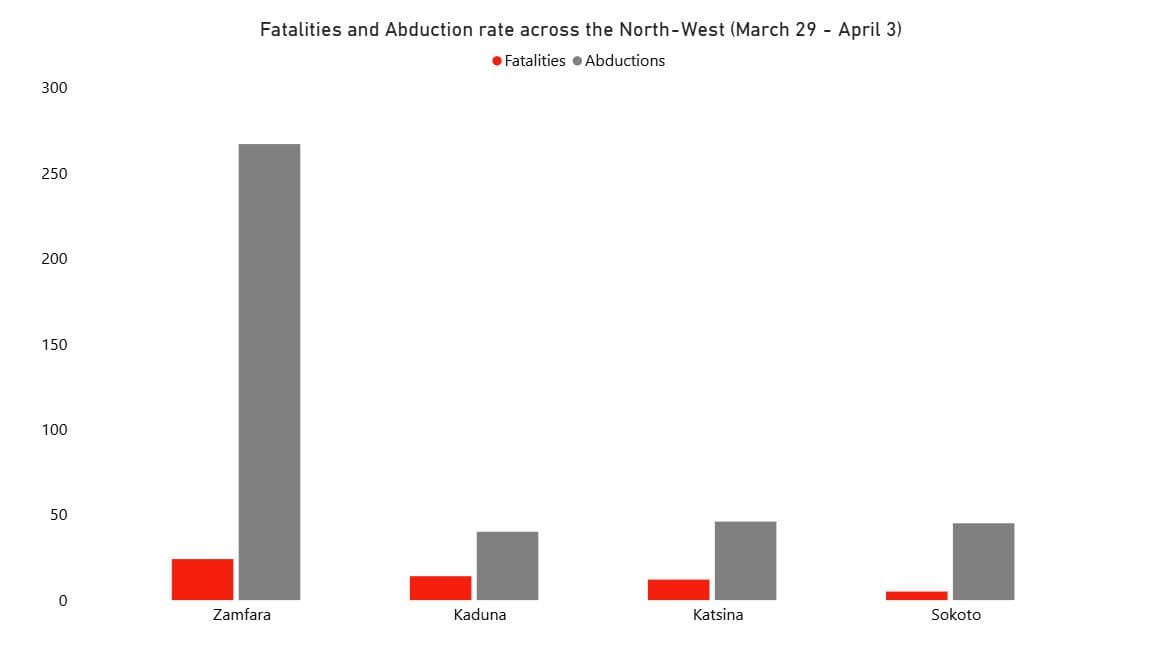
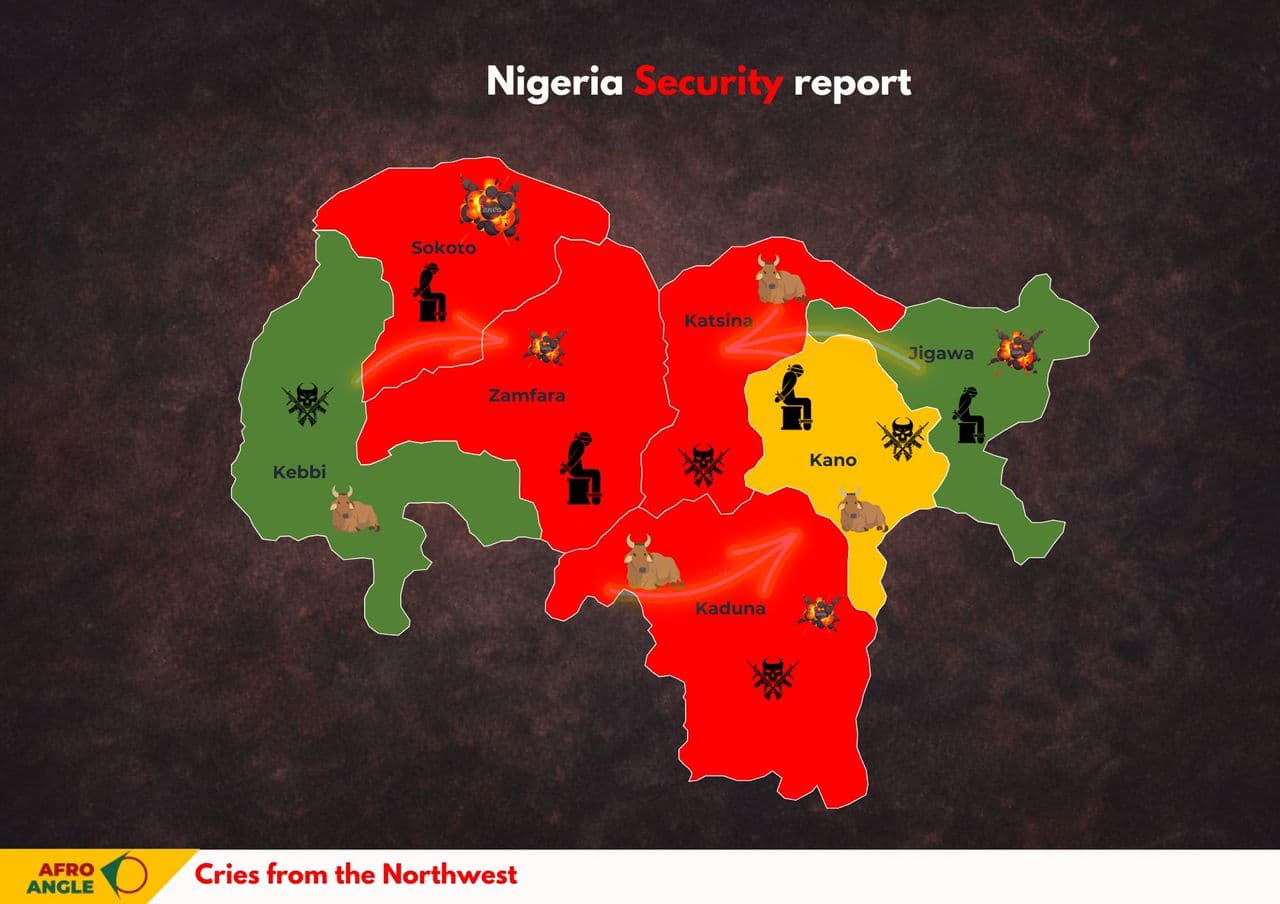
Lethality has followed a similar, grim curve. Fatalities recorded across the Northwest reached 55, a 162% increase from the 21 deaths reported the week prior. Geographically, the epicentre of violence has shifted back to Zamfara State, which has now overtaken Katsina as the region's most volatile theatre. Zamfara accounted for 14 distinct attacks, 24 fatalities, and 267 abductions within this seven-day window. The tactical profile of these groups in Zamfara is increasingly insurgent in nature, characterised by the use of heavy weaponry and sophisticated ambush techniques (IEDs). Despite intensified military pressure, the sheer volume of these indices suggests that armed groups are expanding their zones of influence faster than the state can contain them, leading to the deepening isolation of rural populations and a burgeoning humanitarian crisis.
Analysis: Looming 2027 Elections and Insurgent Leader’s Death Set to Reshape Security Landscape
Two critical trends dominated this reporting period; the paralysis of major transit corridors and the catastrophic scale of mass abductions. The region recorded four major highway incidents, primarily along the Kaura Namoda-Gusau road and the Mayanchi-Sokoto highway. These are not merely security lapses; they are economic blockades. In one Gusau-bound incident, a civilian was killed, and 20 others were abducted; in another, 20 travellers were kidnapped on the way to Sokoto.
Bandit groups are effectively severing the arteries that connect the rural Northwest to urban markets, turning federal highways into kill zones and abduction points. These attacks have immediate implications for the movement of agricultural produce and humanitarian aid, potentially inducing artificial scarcity and price hikes that exacerbate regional instability.
Simultaneously, the scale of rural abductions has reached a breaking point. In a single, devastating event in Zamfara, bandits kidnapped at least 150 people. In another raid, 22 villagers were kidnapped in Maradun LGA. These mass-casualty abductions serve a dual purpose: they provide an immediate, massive infusion of financial resources into the bandit economy through ransom payments, and they shatter the psychological resilience of rural communities, forcing them into protection tax agreements. This strengthening of bandit coffers allows these groups to acquire more sophisticated weaponry, creating a self-sustaining cycle of violence that the current security posture is struggling to interrupt.
Amidst this chaos, the killing of Dando Sibu, the purported Northwest head of the Lakurawa group, introduces a significant variable. Sibu reportedly succumbed to injuries sustained during clashes with security forces in Kebbi State. While the group has yet to officially acknowledge his death, the loss of a senior ideologue and strategist usually leads to one of two outcomes: a temporary operational lull as the group reorganises, or a violent succession struggle that spills over into civilian areas. For the vulnerable communities in Kebbi and Sokoto who currently live under Lakurawa’s shadow, this leadership vacuum is a period of high anxiety. The state must move quickly to fill this void with governance, or risk a new, perhaps more radical, commander taking the reins.
In addition, there is the distraction of the 2027 effect. Major political officeholders are increasingly occupied with party conventions and the alignment of interests ahead of the next election cycle. History in Nigeria suggests that as the political temperature rises, security often becomes a secondary consideration to full-time politicking. While the political class will continue to demand results from the military, the diversion of administrative energy and resources toward campaigns could undermine the long-term, non-kinetic strategies needed to stabilise the Northwest. The tense political landscape creates a distraction window that armed groups are historically adept at exploiting.
Outlook
In the coming weeks, we anticipate a surge in military counter-offensives as the state seeks to capitalise on the death of Dando Sibu to weaken the insurgent group. However, bandit groups are likely to maintain their high-tempo abduction strategy as they race to consolidate funds before the peak of the rainy season limits their mobility. The activities of Lakurawa require meticulous monitoring; a revenge surge or a fractured internal power struggle remains highly probable. Furthermore, spillover effects from ethnic and communal tensions in the North-Central region, particularly around Jos, may be exacerbated by the hardening of political identities as the election cycle nears.
A durable, community-based early-warning strategy is no longer a luxury but a necessity. Security forces must prioritise the protection of rural agrarian hubs and the choke points on federal highways to prevent a total collapse of regional commerce. As the political landscape becomes increasingly preoccupied with 2027, the primary challenge for the security establishment will be maintaining operational focus in a climate of growing administrative distraction. The Northwest remains at a crossroads where tactical military successes must be urgently anchored by sustained political will and rural protection.
Afroangle Intel Admin
Northwest Nigeria Report Admin
comments
No comments yet