
Nigerian Army Expands Its Operational Footprint, creates new divisions
by
Northern Nigeria Security Situation Report (July 26 – August 1, 2026)
Introduction
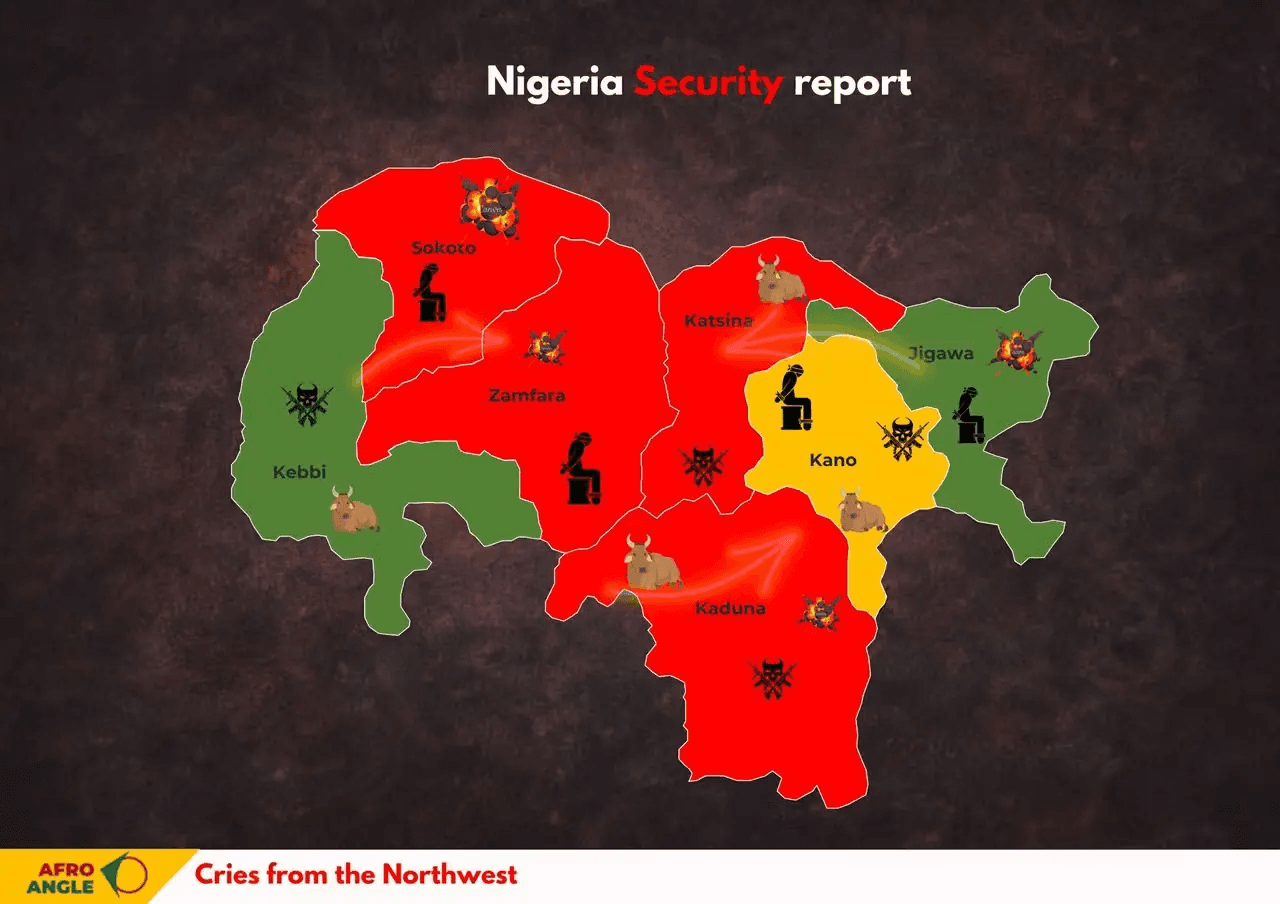
A significant trend that the Afroangle intelligence team reported and monitored in last week's report, where influential individuals in the north-west region, re-emerged this reporting week. This follows the failed attack on a Shariah court judge in the Matazu area of Katsina State. This event points to a growing trend of armed groups targeting local government officials in the region, a trend that suggests a possible attempt to rid these communities of any state presence in areas under their control. A brutal incident in Kauru local government in Kaduna State led to the killing of 30 civilians, mostly women and children, demonstrating the growing threat against vulnerable groups.
The region also witnessed significant counter-terrorism operations against armed groups, with one leading to the recovery of over 100 rustled cattle in Bakori local government of Katsina State, and troops rescuing 48 abducted civilians after a bandit attack in Kaura Namoda local government in Zamfara State. Cattle rustling was also widespread during the reporting period, with one incident in Rabah local government, Sokoto, where armed groups reportedly rustled more than 1,000 cattle in the state.
In the north-central, a top intelligence officer from the Nigerian military intelligence agency was killed in Abuja, highlighting the increasing security threats creeping into the country's capital. Similarly, in Kwara, a counter-terrorism operation led by the DSS resulted in the rescue of nine kidnapped victims and the neutralisation of three suspected bandits, during a fierce exchange of fire in Ekiti local government of Kwara. The victims were reportedly kidnapped from different parts of neighbouring Ekiti State and Kwara, and were being moved towards a stronghold in forest areas straddling Kwara and Niger states. The kidnapping of victims in border areas of Ekiti State demonstrates the gradual spillover and expansion of the threat from Kwara towards the south-west, reinforcing concerns about the deteriorating security situation in south-west states, and at-risk states such as Oyo and Ekiti, due to spillover from neighbouring Kwara State.
In the north-east, the Nigerian military continues its sustained offensive into insurgent strongholds, and has stepped up its crackdown informants, collaborators and logistics suppliers, in an attempt to cripple the networks that sustain the insurgency in the north-east, while ramping up pressure with ground offensives across Yobe and Borno.
Meanwhile, insurgents continue planting explosives devices (IEDs) across Borno State in an effort to slow down the troops' offensives. Three foiled IEDs were reported during the reporting week in Borno, around Dikwa, Gonin Masari and Bulabulin general area. Another reported development in the north-east is the clash between the Boko Haram-linked JAS group and ISWAP in areas around Lake Chad, while it cannot be independently verified, it pointed to a resurgence in the internal rivalry that has dominated the region's insurgency landscape, particularly involving both groups' struggle for influence. It is, however, unclear whether this is just an episodic clash or whether it could potentially spark more clashes between both groups in the coming weeks.
Weekly Review
Data from the North-West during the reporting period highlights a broader dynamic that extends beyond the region itself and reflects a recurring feature of Nigeria's wider conflict landscape. The region recorded no confirmed cases of abductions during the week, while fatalities declined from 61 to 46 despite the mass-casualty attack in Kauru Local Government Area of Kaduna State. Security incidents also fell sharply, dropping from 31 the previous week to 14, representing a 55% reduction. On the surface, these figures suggest an improvement in the security environment. However, they should be interpreted with caution.
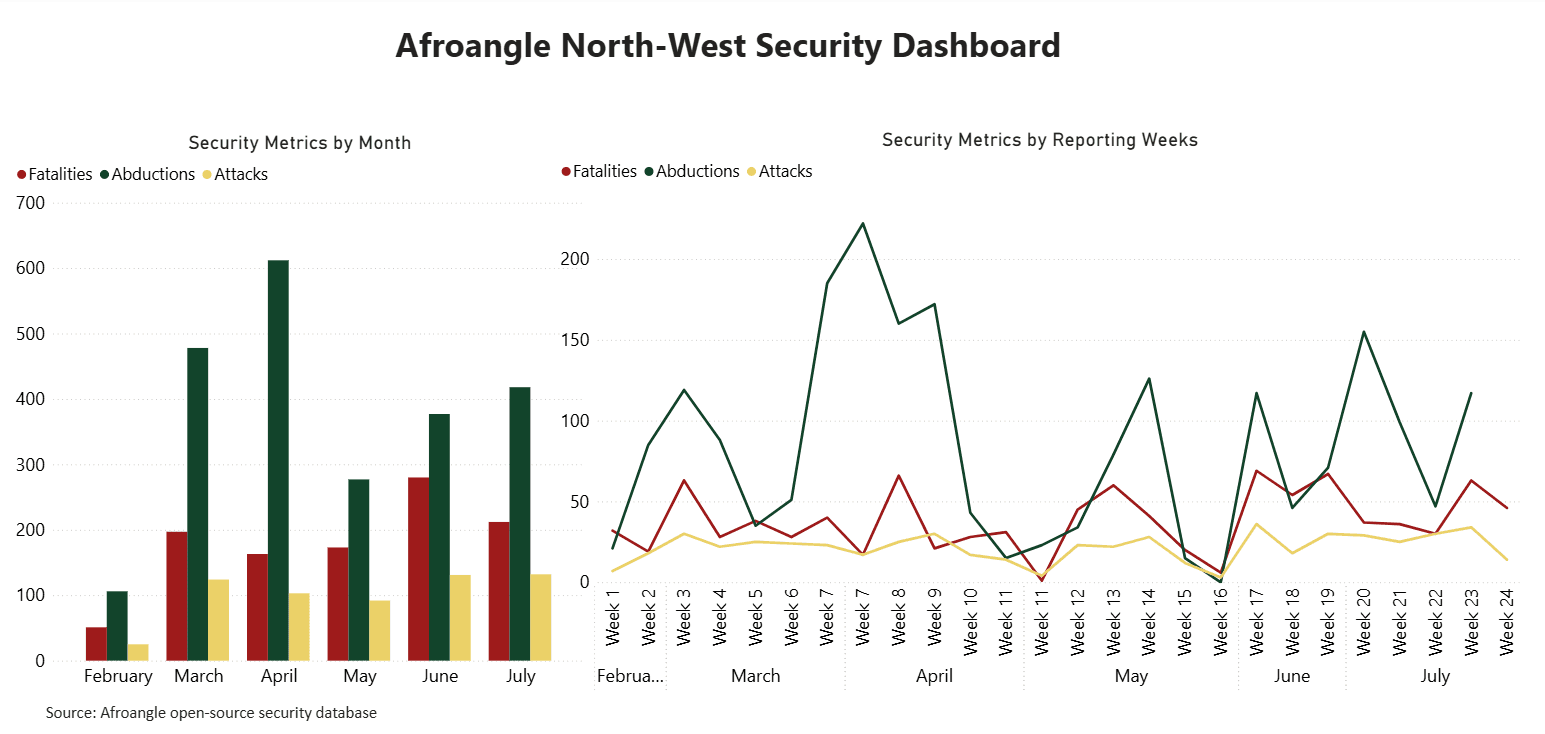
The decline in reported incidents may, in part, reflect the impact of sustained military operations across the region. At the same time, it is equally important to consider the effect of reduced information flows from conflict-affected areas. During the reporting period, AfroAngle security sources reported significant challenges in obtaining information from parts of Katsina, Sokoto and Zamfara following the directive by the Operation Fansa Yamma theatre command to suspend telecommunications services for operational purposes. While such communication restrictions can support military operations by disrupting armed groups' coordination, they also reduce the visibility of security incidents, making it more difficult to assess the true scale and distribution of violence. This remains an important but often overlooked factor when interpreting conflict data from northern Nigeria.
At the state level, both fatalities and incidents were concentrated across Kaduna, Sokoto, Katsina and Zamfara, although the distribution was uneven. Kaduna accounted for 31 fatalities, largely driven by the attack in Kauru Local Government Area, while Sokoto recorded seven fatalities and Zamfara four. Katsina registered five reported incidents during the week. The concentration of casualties in a single high-impact attack illustrates how isolated but severe incidents can disproportionately shape regional security metrics, underscoring the need to assess weekly trends alongside the operational context rather than relying solely on aggregate figures.
Analysis: Nigeria's Army Operational Strength Spread Out Across the Country
The Federal Government's decision to expand the Nigerian Army from eight to twelve divisions marks one of the most significant structural changes to the country's military in recent years. The move is intended to strengthen internal security, improve operational effectiveness, and position the Army to respond more effectively to Nigeria's increasingly complex security environment.
The four new divisions, located in Ilorin, Jalingo, Benin City and Makurdi, are expected to enhance command and control, improve force projection, and reduce response times across key operational theatres. Their locations are far from arbitrary. Each sits within or close to areas where the security environment has deteriorated in recent years, suggesting that the expansion is driven, at least in part, by evolving threat dynamics rather than administrative convenience.
The redistribution of the Army's command structure also reflects a deliberate effort to improve nationwide military coverage. Under the new arrangement, the North-East now hosts three divisions, the South-East retains one, while the remaining geopolitical zones each have two. This configuration broadly aligns with the country's current security realities, where threats are no longer confined to a single theatre but are increasingly dispersed across multiple regions.
Among the new formations, the establishment of the 9 Division in Ilorin is particularly significant. The division will oversee operations across Kwara and Niger States, supported by the newly established 29 Brigade in Kainji. This Kainji corridor has become increasingly important in recent months as armed groups exploit the Kainji-Borgu axis to move fighters, coordinate attacks and establish logistical routes between the North-Central and North-West. The same corridor has also been linked to the movement of transnational militant groups such as JNIM, underscoring its growing strategic importance. Positioning a divisional headquarters in Ilorin therefore reflects an operational response to a changing threat environment rather than a routine expansion of military infrastructure.
Beyond the security rationale, other explanations have emerged for the timing of the restructuring. One possibility is that the expansion is partly informed by lessons from the failed coup attempt in 2025. A more geographically dispersed command structure could complicate the coordination of any future attempt by reducing the concentration of military assets and command authority in a limited number of locations. Others argue that political considerations may also have influenced the choice of some locations, particularly in states where the ruling party maintains strong political support. While these interpretations remain speculative, they illustrate the broader debate surrounding the government's decision. Regardless of the underlying motivations, the more pressing question is whether the expansion can be sustained over the long term.
New Divisons Created
Creating new divisions is only the first step. Maintaining them will require substantial and sustained investment at a time when Nigeria continues to face significant fiscal constraints. A division is far more than a headquarters or administrative formation; it is a complex fighting organisation that depends on adequately equipped infantry, armour, artillery, engineers, intelligence, signals, logistics, medical services and other supporting arms. Persistent concerns over the readiness and resourcing of some existing divisions raise legitimate questions about whether the new formations will receive the personnel, equipment and funding required to operate at full capacity rather than simply expanding the Army's organisational structure on paper.
Potential Challenges of Adequate Manpower
Manpower presents an equally significant challenge. The government's plan to recruit an additional 28,000 personnel demonstrates recognition of this requirement, but questions remain over whether that number will be sufficient. International benchmarks generally place the strength of a fully operational division at around 20,000 personnel, although actual force sizes vary depending on doctrine, mission and force structure. If the new divisions are staffed primarily by redistributing personnel from existing formations, the Army risks weakening established units in order to strengthen new ones, creating capability gaps elsewhere. Such an approach would undermine the strategic objective of expanding operational capacity.
Opportunities for Building and Maintaining Capable Units
Ultimately, the effectiveness of the expansion will depend less on the number of new headquarters than on the capability they bring to the battlefield. The new divisions should be developed as fully integrated combined-arms formations, capable of synchronising infantry, armour, artillery, engineers, intelligence, signals, aviation, air defence, logistics, medical services and special operations under a unified command. Equally important are sustained investments in personnel welfare, training, equipment and operational readiness. Without these foundations, the expansion risks becoming a symbolic increase in military infrastructure rather than a meaningful enhancement of Nigeria's ability to respond to evolving security threats. With them, however, the new divisions could significantly strengthen the Army's capacity to project force, sustain operations and respond more effectively across multiple theatres simultaneously.
Outlook
In the coming month, the northern security landscape will remain volatile, with attacks on civilian communities across the north-west and north-central by armed groups, while the Nigerian military will continue to sustain its offensive against insurgents in the north-east. In an effort to stall the military's efforts, Nigerian troops in the north-east should remain vigilant for IEDs laid along roads, as this is a pattern the armed groups are likely to sustain and continue in the coming weeks as they come under pressure. Similarly, the Nigerian military should continue to monitor any potential clashes between JAS and ISWAP in the Lake Chad area in the coming weeks, and leverage that internal rivalry for operational advantage. In the north-central, armed groups will continue to leverage the porous forested areas for the movement of kidnapped victims and fighters, and will potentially gradually expand deeper into the south-west — Oyo being a case in point given the recent kidnapping — with Ekiti also needing to increase and buffer its security along the border with Kwara. In the north-west, the continued targeting of local government officials should be investigated, and security forces should provide adequate protection for high-level government officials in states such as Kebbi, Zamfara and Katsina in the region.
Afroangel Intel Admin
Afroangle Intel Admin
comments
No comments yet