
The Voice of the Hunter: Remembering Àlàbí Ògúndépò and the Changing Face of Ìjàlá
by
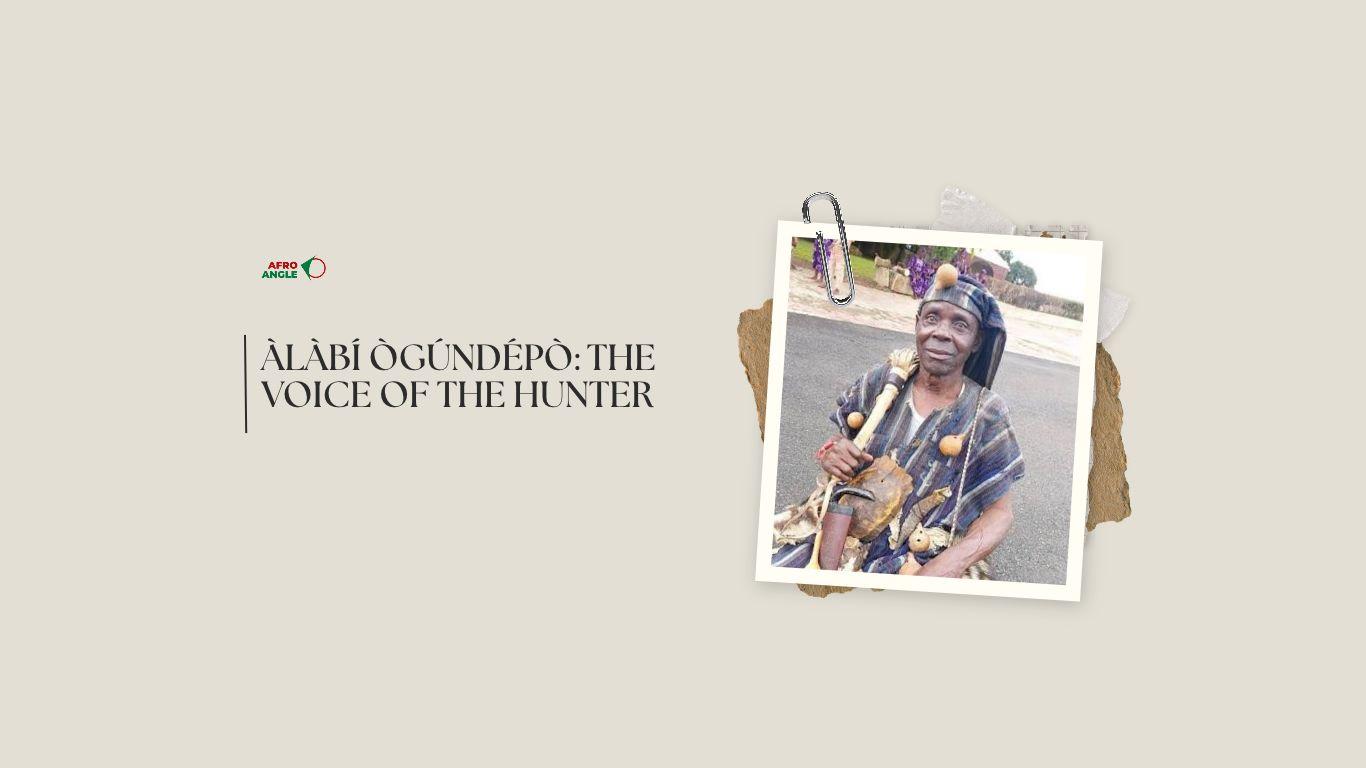
The death of Àlàbí Ògúndépò marks the pivotal end of an era in the history of folk performance of the Yoruba people. For more than six decades, Àlàbí Ògúndépò used his voice as a bridge across generations to carry Yoruba hunters’ poetry from the margin of traditional performances into theatre, recording studios, radio, television stations, advertising arena, and films. He died on 24 August 2026 at the age of 84, leaving behind one of the most enduring bodies of work associated with Ìjàlá, a Yorùbá poetic tradition associated with hunters, which he inherited from his family and spent his life adapting to a changing society.
From Family Tradition to the Stage
Born in 1942 to Ìjàlá poets, Fátókún and Ògúnrìnọlá of Saki, Oyo State, Ògúndépò encountered the tradition from childhood. He initially imitated his parents and older siblings before distinguishing himself by performing curtain-raisers for adult performers and making occasional appearances at primary school events. His entry into modern performance came when he joined Adejobi Theatre Company, a travelling theatre troupe founded by dramatist and actor Oyin Adejobi.
His career developed at a time when Yoruba performance poetry was undergoing a significant transition. Traditional poets were moving from largely one-off live performances towards recordings and broadcasts, while radio and television created new audiences and commercial opportunities. Government agencies, politicians, businesses, and traditional institutions increasingly became patrons of performers, commissioning them for jingles, advertisements, political messages, royal occasions, and public enlightenment campaigns.
Ògúndépò adapted to this changing environment. His performances, once dependent largely on memory and live interaction, became scripted. He regarded writing as compatible with modernity, using it as a means of preserving performances and responding to the growing demand for poetry tailored to radio, television jingles, political campaigns, and advertisements.
Ògúndépò attended Modern School (an intermediate form of education between primary and secondary school) up to the first year before leaving because his family could not afford to continue funding his education. Yet his encounter with literacy continued to shape his career. After his appearance in Kongi’s Harvest, he stayed at the School of Theatre at the University of Ibadan, then headed by Wole Soyinka, where he studied for a certificate.
From Kongi’s Harvest to the Airwaves
Ògúndépò’s appearance in Kongi’s Harvest in 1970, directed by Ossie Davis and adapted from Wole Soyinka’s play, was one of his earliest screen appearances. He played Agúnlèyìnoyè, the court poet, bringing his experience as an Ìjàlá performer into a production centred on the conflict between traditional authority and modern political power.
His more lasting influence, however, was heard beyond the cinema. He became associated with Radio Oyo, now part of the Broadcasting Corporation of Oyo State, and the Nigeria Television Authority, particularly NTA Ibadan. He featured in broadcasts, jingles, advertisements, and public-service messages and produced Akiika, a cultural programme on NTA Ibadan that promoted Yoruba language, oral literature, history, and traditions.
His voice became part of the everyday soundscape of Yoruba-speaking Nigeria. One of his most memorable public-service messages was the road-safety campaign, “Eso Pele Onimoto Rora Saare”, which warned motorists against reckless driving. His professional engagements with Radio Oyo and the Nigeria Television Authority also brought him into the same broadcasting and performance circuit as figures such as poets Olatubosun Oladapo and Adebayo Faleti, contemporaries who also contributed to the development of Yoruba literary performances.
His recording history had begun at least as early as 1971, when several of his Ìjàlá performances were recorded by researcher and translator Val Olayemi and preserved in the Institute of African Studies’ Archive of Sound and Vision at the University of Ibadan. These included Kádàrá ’ò Gb’óògùn, Òrùn Nílé, Owó Apẹ̀kànùkò, Oluwa Má Jẹ́ n Sófò Àlè, Òdálẹ̀ Ọ̀rẹ́, and Bọ̀sẹ̀rẹ̀. By 1977, he had recorded Ọ̀rọ̀ Obìnrin Ìwòyí (Women of Today), a work that has attracted scholarly attention for its treatment of changing social relations and gender.
His recordings became more frequent in the 1980s, including Ìjàlá Arẹ́ Ọdẹ Volumes 1 and 2, recorded for Olatubosun Records in 1981. The recordings reflected his willingness to experiment with the traditional form, incorporating elements of Gẹ̀lẹ̀dẹ́ and folk music. In all, Olatubosun Oladapo Records produced 18 albums for Ògúndépò.
The Poet and Cultural Custodian
Ògúndépò did more than preserve old verses. He used Ìjàlá to preach moral and cultural values while criticising social ills. As his audiences changed, so did the subjects and purposes of his performances. The traditional hunter-poet became a public commentator, using an old form to speak about contemporary life.
His work eventually attracted scholarly attention. Researchers have studied his performances as evidence of how Yoruba oral traditions respond to social change, while his work has also been documented in UNESCO’s Inventory of Nigeria Cultural Resources. UNESCO identified him among prominent professional Yoruba poetry chanters, placing his work within a tradition used to entertain, educate, correct social ills, and transmit Yoruba history and culture.
In 2016, Ògúndépò was contracted to perform Ìjàlá at the Olójó Festival in Ile-Ife, an annual celebration associated with Ògún, the Yoruba deity of iron, war, and craftsmanship, and a former king of Ife. His performance placed his mastery of Ìjàlá within one of the most significant celebrations of Yoruba cultural heritage.
His contribution to Yoruba culture also earned formal recognition. In 2009, the Osun State Government honoured him with a merit award alongside 28 other individuals recognised for excellence and outstanding contributions in their respective fields. He was also later honoured by the Oríkì Yoruba Festival alongside other distinguished Yoruba cultural figures, including Olatubosun Oladapo, Ajobiewe, Wande Eesa, Muraina Oyelami, Yemi Elebuibon, and Kola Oyewo.
What He Leaves Behind
If there is one thing Ògúndépò’s life demonstrated, it is that formal Western education is not the only route to intellectual or cultural mastery. He learned largely through observation, imitation, practice, and performance. From watching his parents and older siblings, he developed a command of Ìjàlá that eventually carried him from traditional performances to the theatre, recording studio, radio station, television, film sets, and cultural festivals.
His greatest contribution was not simply that he performed Ìjàlá for many decades. It was that he demonstrated that the form could change without ceasing to be itself. He took hunters’ poetry into spaces its earliest practitioners could hardly have imagined: radio jingles, television programmes, commercial recordings, public-service announcements, political communication, theatre, and film.
That makes his death more than the loss of another veteran performer. Ògúndépò possessed a combination of memory, voice, cultural knowledge, and adaptability that is difficult to reproduce. His Ìjàlá was recognisable not only because of what he said, but because of how he said it. He could entertain, admonish, educate, praise, criticise, and preserve memory through the same poetic tradition.
The society that produced Ògúndépò has changed. Oral traditions now compete with television, social media, streaming platforms, and increasingly short forms of digital entertainment. Yet his career offers a lesson that remains relevant: cultural traditions do not necessarily survive by remaining unchanged. They survive when people understand them deeply enough to carry them into new spaces.
Till his last breath, Ògúndépò remained a performer and promoter of Yoruba oral culture. His passing leaves a question larger than the survival of one man’s repertoire: who will give the old voice a new audience? His legacy will ultimately depend not on finding someone who sounds exactly like Àlàbí Ògúndépò, but on whether another generation can possess the same courage to preserve Ìjàlá while allowing it to speak to a changing world.
Samuel Omofala
Samuel Omofala is a journalist, law student, and award-winning essayist with a strong focus on entertainment, culture, and the economy. In 2025, he won the 7th edition of the prestigious Fisayo Soyombo Inter-varsity Essay Contest, beating over one hundred other entries. His contributions to campus journalism at the University of Ibadan have earned him significant recognition, including Most Energetic Campus Journalist (Administrative), a nomination for Most Promising Campus Journalist, and leadership of a local press organisation.
comments
No comments yet