
Armed groups impose levies on communities amid sporadic attacks.
by

North-west Nigeria: Security Situation Report (May 3 - May 9, 2026)
Introduction:
The North-west region is currently experiencing a moderate decline in violent activities, marking the second such reduction reported by Afroangle since the the April 19–25 reporting period. This downward trend is largely attributed to intensified counter-terrorism operations and the onset of the rainy season, but most significantly, it suggests a tactical pivot by bandits and Lakurawa-linked insurgents who have begun imposing protection and farming taxes as the agricultural season approaches. While overall violence has decreased, this shift does not imply the elimination of the threats posed by these groups. During the reporting period of May 3 to May 9, the region still recorded violent attacks across Zamfara, Katsina, and Kebbi, as well as in the traditionally stable but increasingly volatile state of Kano. Armed groups continue to raid communities, abduct locals, target highways, and launch assaults on both community security forces and military outposts.
A significant development during this period was an Improvised Explosive Device (IED) explosion along the Bagega–Anka route in Zamfara State, which resulted in the death five civilians and highlighted the growing adoption of sophisticated insurgent tactics that endanger both non-combatants and security forces on critical transit routes. Simultaneously, an attack in Kano resulted in four civilian injuries and a large-scale cattle rustling operation, signaling a concentrated expansion of violence into one of Northern Nigeria’s most economically vital hubs. Kano has seen a rise in bandit incursions since late 2025, largely following peace deals struck between communities and bandits in Katsina, which have effectively pushed the theatre of violence eastward. These incidents confirm that armed groups are expanding their geographic reach, with Kano becoming an increasingly central focus for their operations.
Furthermore, the concerns regarding the imposition of levies, a trend repeatedly highlighted in previous Afroangle reports, are now materialising. Recent reports indicate that bandit groups are successfully enforcing protection and farming fees on rural populations, particularly across Katsina. This development has dire implications; beyond increasing the immediate vulnerability of these communities to systemic extortion, the added financial burden on the agricultural sector poses a severe threat to regional and national food security. As armed groups consolidate their economic influence over the farming cycle, the long-term stability of the region’s agricultural output remains at high risk.
Week in Review
A comparative analysis of this reporting period against the previous week indicates a moderate increase in attacks and fatalities, and a decline in abductions in the North-west, with some fluctuation in specific metrics. Recorded incidents rose slightly from 18 to 19, representing a 6% increase in the operational tempo of attacks. Conversely, abductions saw a significant reduction, dropping from 38 to 28 and marking a 26% decline in kidnapping activities targeting both rural residents and commuters along major highways. Fatalities, however, remained high at 36—a jump from the 32 recorded previously—representing a 12.5% increase. This divergence across security metrics reveals the complex and shifting nature of the threat landscape across the region.
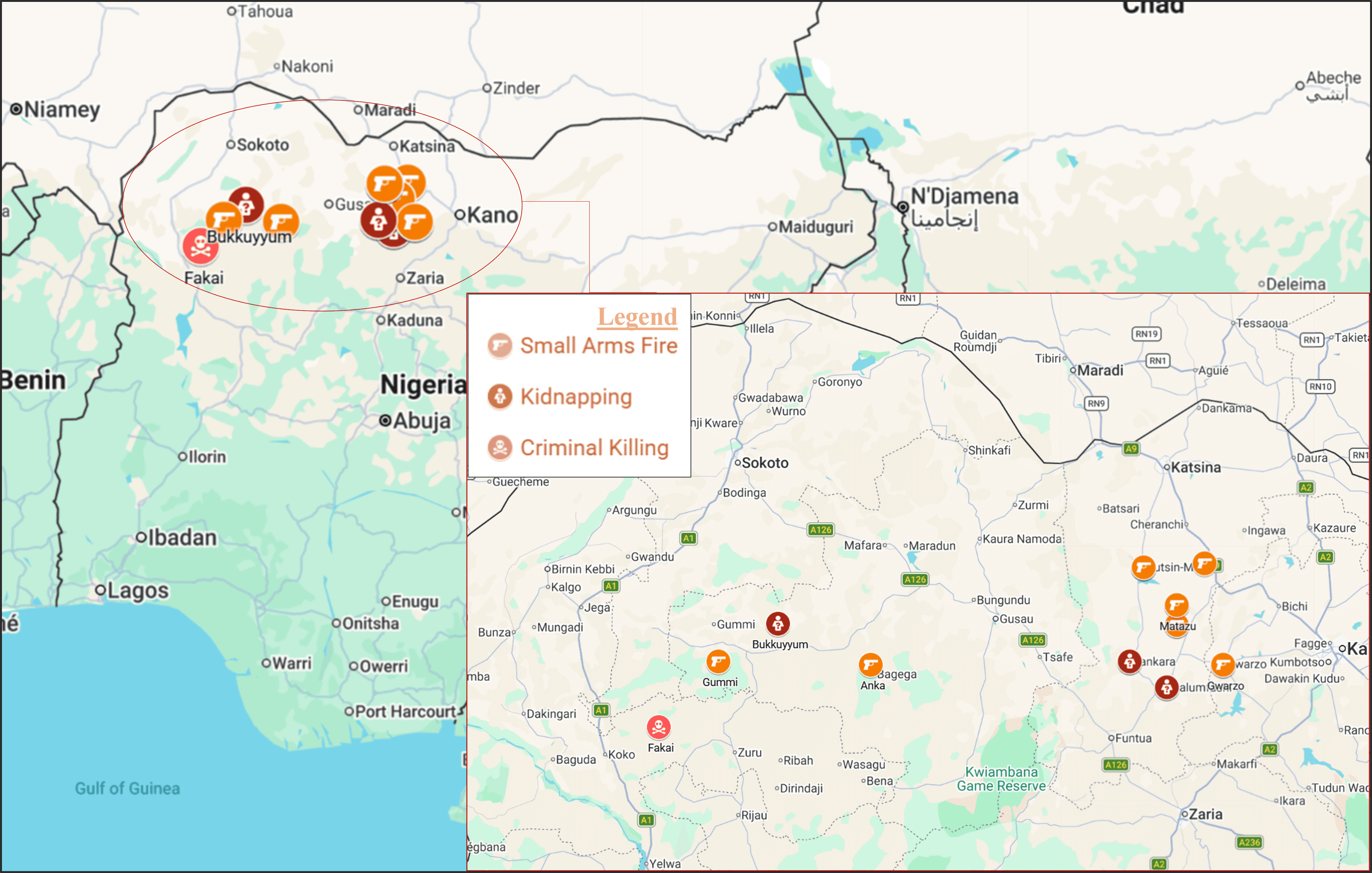
Regionally, violence remained heavily concentrated in Katsina State, which continues to serve as the epicenter of armed group activity. During this period, the state recorded 12 distinct incidents resulting in 28 fatalities and 22 abductions. This data highlights a significant concentration of violence within a single state, even as other areas continue to experience violent activity.
Bandits Continue to Impose Levies on Local Communities
Armed bandits across the region have shifted their focus toward imposing heavy levies on remote communities as the rainy season approaches, seeking both to extract resources and to tighten their influence. During the reporting period, two significant cases of extortion were recorded. In Katsina State, fighters loyal to the notorious Isiya Kwashen Garwa imposed a ₦10 million levy on the Garin Lamido and Yan Shuni communities in Bakori Local Government Area. In another disturbing development, residents of Mazoji village in Matazu Local Government Area were served a demand for ₦30 million. These taxes are ostensibly levied to ensure community protection and grant access to farmlands, promises these armed groups have repeatedly violated in previous negotiations.
In Katsina specifically, these renewed demands come despite several peace agreements reached between various local government authorities and armed groups. Approximately 20 local governments finalised such agreements in late 2025 and have since been discarded by the bandits, with early 2026 witnessing a surge in violent attacks that effectively nullified the negotiated deals. This pattern suggests that armed bandits view peace treaties not as permanent resolutions, but as tactical pauses to regroup before resuming violent activities and extortion.
The imposition of these levies carries severe implications for both communal stability and regional security. Fearing imminent assault if they fail to pay, many residents are fleeing to relatively stable areas, which further exacerbates the already dire humanitarian situation. Simultaneously, these demands threaten to halt agricultural activity entirely; farmers are either too afraid to enter their fields or are forced to flee for safety. This creates a dual economic crisis: if farmers pay the levies, the additional costs will likely be passed on to consumers, driving food inflation. Conversely, if farming is abandoned, the resulting scarcity of agricultural produce could lead to widespread food shortages in a region already grappling with high levels of displacement. Ultimately, the payment of these levies serves to embolden armed groups, providing them with the financial capital to expand their operations and influence across more rural settlements.
Outlook
In the coming weeks, armed group activity is expected to persist, though the region may witness a moderate decline in overt violent clashes as the military continues its offensive. However, this shift likely signals a transition toward the systemic harassment of communities and the enforcement of illegal levies for protection and land access. The onset of the rainy season is expected to stall conventional troop movements and logistical operations, potentially creating security vacuums. Armed groups are likely to exploit these gaps to expand their territorial reach and exert greater control over vulnerable rural populations.
Afroangle Intel Admin
Northwest Nigeria Report Admin
comments
No comments yet