
Shadow War in the Central Sahel: The Escalating Niger–Chad Crisis
by

Why Conflict Continues to Escalate Around the Chad Basin
Tensions between Niger and Chad have escalated into a dangerous rift, with the potential to alter the security architecture of the Central Sahel. The alleged Chadian drone strike on Niger’s territory, which initially appeared to be a routine border clash, has exposed deep geopolitical rivalries, proxy networks, and competing foreign alliances, whose effects could spill across the region. The current crisis escalated rapidly following two key incidents in late 2026. Tensions first flared during an attempted military mutiny in Niamey targeting Air Base 101 and the Presidential Palace. In the aftermath, Niger’s military government explicitly accused Chadian military officers and French special forces of coordinating with the mutineers to destabilise the regime of General Abdourahamane Tiani.
Relations deteriorated further following the reported drone attack in the Emi Lulu area of the Salvador Pass in late October, located in northern Niger’s Agadez region near the Algerian and Libyan borders. The drone strike was reportedly launched from Chadian airspace, killing two civilians and destroying military and civilian vehicles. Nigerien authorities denounced the attack as an unprovoked violation of national sovereignty, placed their air force on high alert, and summoned Chad’s ambassador to issue a formal protest.
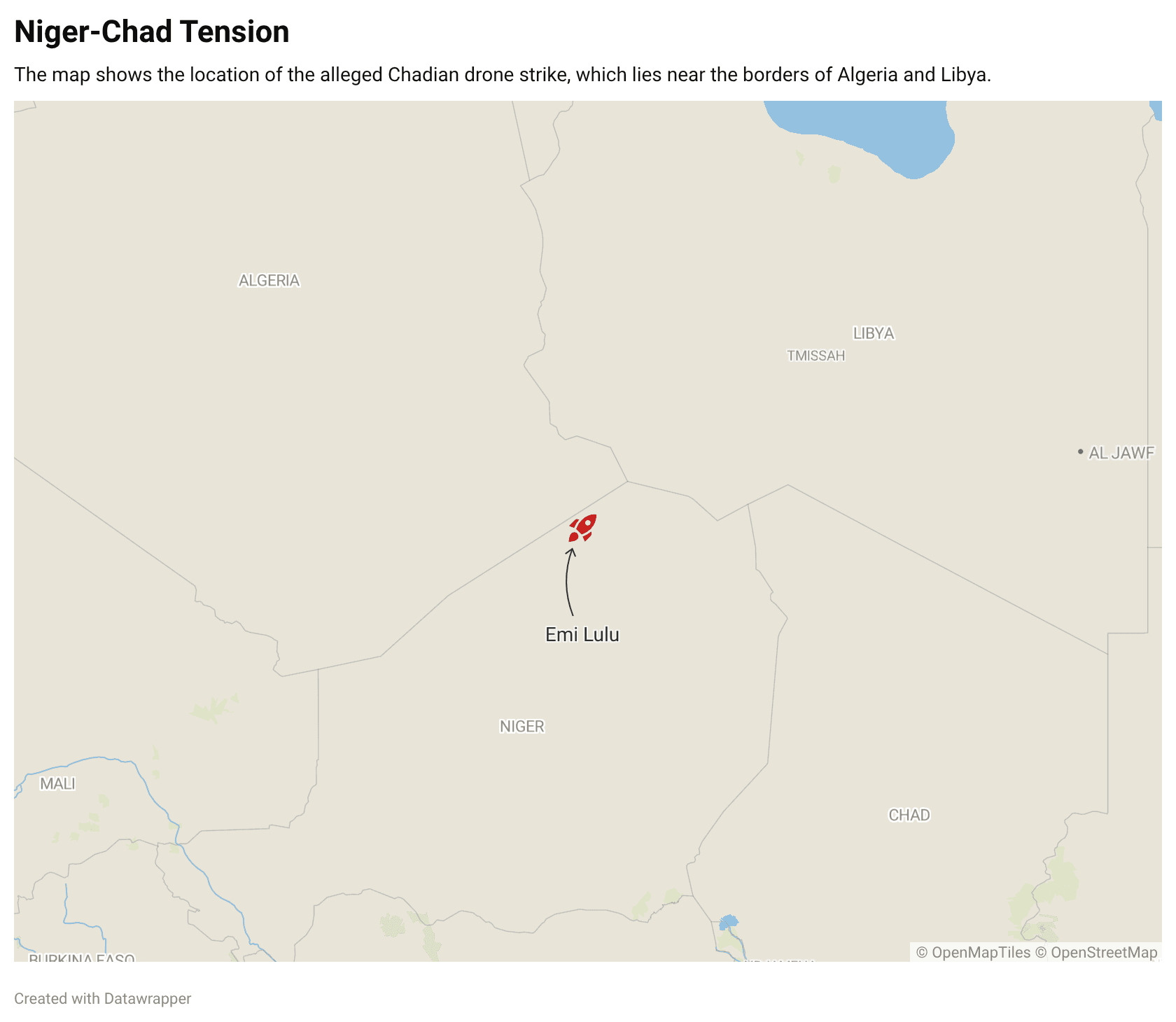
The claim was firmly refuted by Chadian authorities, who clarified that their military had conducted strikes in northern Chad’s Tibesti region against internal rebel groups, specifically the Miski Self-Defence Committee, and had not targeted Nigerien territory. Chad instead counter-accused Niger of harbouring anti-Déby armed groups, setting off a cycle of mutual recriminations.
Factors Driving the Ongoing Conflict
Mainstream media coverage has largely focused on the border strikes and the subsequent diplomatic fallout. However, the incident occurred against a backdrop of overlapping crises involving structural tensions, proxy rebellions and competing foreign influence networks.
Following Niger’s July 2023 coup, Niamey expelled French forces, terminated defence pacts with Western powers and anchored its regime survival to Russia’s Africa Corps under the Alliance of Sahel States (AES) confederation, alongside Mali and Burkina Faso. Conversely, Chad temporarily reduced its French military footprint; however, President Mahamat Idriss Déby recently renewed high-level military cooperation with Paris. From Niamey’s perspective, N'Djamena’s return to France’s defence orbit has repositioned Chad as a Western proxy operating on the doorstep of the AES.
Second, while public rhetoric in Niger has largely focused on French interference, the growing influence of the United Arab Emirates (UAE), a critical financial and military backer of Chad, is also contributing to the strained relations. Niger recently moved closer to Algeria, while Algeria, in turn, recently severed ties with the UAE following accusations of Emirati destabilising activities in the region, particularly in the Sudan conflict. Eastern Chad has played a key role in providing logistical support to the UAE-backed Rapid Support Forces (RSF) fighting in Sudan. Niger may therefore view the alleged Chadian drone strike as part of the UAE’s effort to undermine its relationship with Algeria, particularly as Algeria’s growing military presence in Niger is perceived as a challenge to competing regional interests.
Relatedly, the crisis further unfolds as Algeria considers expanding its military and security presence in northern Niger near its border. Driven by concerns over border security and vital energy assets, including trans-Saharan pipelines, Algiers has moved closer to Niamey. This growing alignment risks intensifying regional rivalries with the competing strategic axis formed by the UAE, Chad and Khalifa Haftar.
Lastly, the Niger–Chad frontier has increasingly become a mutual proxy arena. Niger regularly accuses Chad of allowing its territory to serve as a rear base for hostile Nigerien insurgents, notably the Patriotic Movement for Liberty and Justice (MPLJ), led by Moussa Kounaï. In response, Niger is accused of offering sanctuary to Chadian rebel factions. Prominent among these is the Front for Change and Concord in Chad (FACT), led by Mahamat Mahadi, which launched the 2021 northern offensive that resulted in the death of former Chadian President Idriss Déby Itno. Facing mounting pressure from N'Djamena, Niger may be tempted to ease restrictions on FACT and other Chadian opposition groups operating on its soil, using them as asymmetric leverage against the Déby administration, and vice versa.
Impact on Regional Stability
The breakdown in Niger–Chad relations carries severe long-term consequences for the security dynamics of Central and West Africa.
- First, the feud threatens cross-border counter-terrorism cooperation and efforts to combat transnational criminal activity. The militaries of Chad and Niger have previously conducted joint operations against criminal elements, using cross-border routes connecting Niger, Libya and Chad to monitor and disrupt illicit activities and the movement of armed rebel groups. The absence of joint border patrols could create security vacuums that terrorist groups and criminal networks may exploit.
- Second, the crisis further deepens regional polarisation, with the region increasingly divided into competing geopolitical blocs. On one side stands the AES confederation of Niger, Mali and Burkina Faso, backed by Russian security assets and maintaining tactical alignment with Algeria. On the other stands Chad, linked to French military structures, Emirati capital and Libyan networks under Khalifa Haftar. This polarisation diminishes the likelihood of unified, intra-African solutions to regional instability, while geopolitical competition between these actors could further entrench and deepen instability.
- Third, if diplomatic channels fail to establish an independent investigation into the reported drone strike and border incidents, the conflict could evolve from formal diplomatic protests into active proxy warfare. Uncontrolled incursions by groups such as FACT or the MPLJ could trigger retaliatory cross-border strikes, potentially drawing the AES into direct military confrontation with Chad and destabilising both governments from within.
In conclusion, the dispute could stall essential infrastructure projects, including prospective secondary trans-African crude oil pipelines intended to link Niger’s oil fields through Chad to coastal export terminals. The militarisation of desert borders could also disrupt informal commercial corridors connecting Agadez and Tibesti, depriving local border communities of trade-based livelihoods and worsening economic vulnerabilities across the Saharan belt.
Afroangel Intel Admin
Afroangle Intel Admin
comments
No comments yet