
How German Language Quietly Shapes Nigerians' Access to Global Education and Labour Mobility
by
Listen to this article
The reactions were swift and adulating when Oluwaseyifunmi Sanni posted photos of herself holding a copy of her final year undergraduate dissertation on X (formerly Twitter) to celebrate her academic milestone in German studies at the University of Ibadan. The tweet generated over 9 million impressions, providing a rare opportunity for questions revolving around the marketability of so-called unmarketable degrees in Nigeria and beyond.
In a world that prizes “safe” degrees like law, medicine, engineering, finance, and information technology, Oluwaseyifunmi’s viral tweet and the wave of posts by students and graduates of foreign languages from different universities in Nigeria revealed that studying a foreign language is not so unpopular after all. But her viral moment did more than spotlight an overlooked field. It opened the floor to a conversation we should be having: what do foreign languages like German language actually offer for access to global education and mobility?
History of German Studies in Nigeria
The story of German studies in Nigeria begins with science in 1948 at the University College Ibadan. The College introduced what it called Scientific German language to its students to serve as a tool for accessing scientific knowledge written in German language. It wasn’t until the years following Nigeria’s independence that the German Academic Exchange Service (DAAD) sent Wilfried Feusser, its first lecturer in Nigeria, to transform that once-upon-a-time modest course into something academically more viable.
His presence in Nigeria did more than just stimulate people’s interest in the German language. He built the system that has produced countless graduates and experts of German Studies in Nigeria, starting at the University of Ibadan and then later proceeding to Obafemi Awolowo University, Ile-Ife.
Wilfried Feusser is most credited for expanding the curriculum of German studies in Nigeria beyond technical vocabulary to include linguistics, literature, culture, and civilisation of the Germans, providing rich resources for cultural exchange between Nigeria and Germany.
His immense contribution to the field as DAAD’s first lecturer in Nigeria helped establish German as a language of global ambition, alongside French, Spanish, Portuguese, Russian, Mandarin, and Arabic, taught across universities and language centers in Nigeria.
How Does German Language Position Nigerians for Global Education and Mobility?
Germany is a leading economic superpower in Europe. Its large economy has driven continuous demand for labour sourced from different parts of the world. As a result, proficiency in German language has become a determinant in how one accesses opportunities to secure a place in German society as a contributor, through work, to its economic development.
Nonetheless, this raises questions regarding Nigeria's economic security, indirectly weakened through brain drain. For many young Nigerians, traveling to countries like Germany has become one of the most viable options for actualizing their dreams. In their view, learning German is indispensable. Some pursue this through academic exposure to German studies, a humanistic discipline like other area studies offered at Obafemi Awolowo University, University of Ibadan, University of Lagos, and University of Nigeria Nnsukka, while others enroll in German language schools like the Goethe Institut.
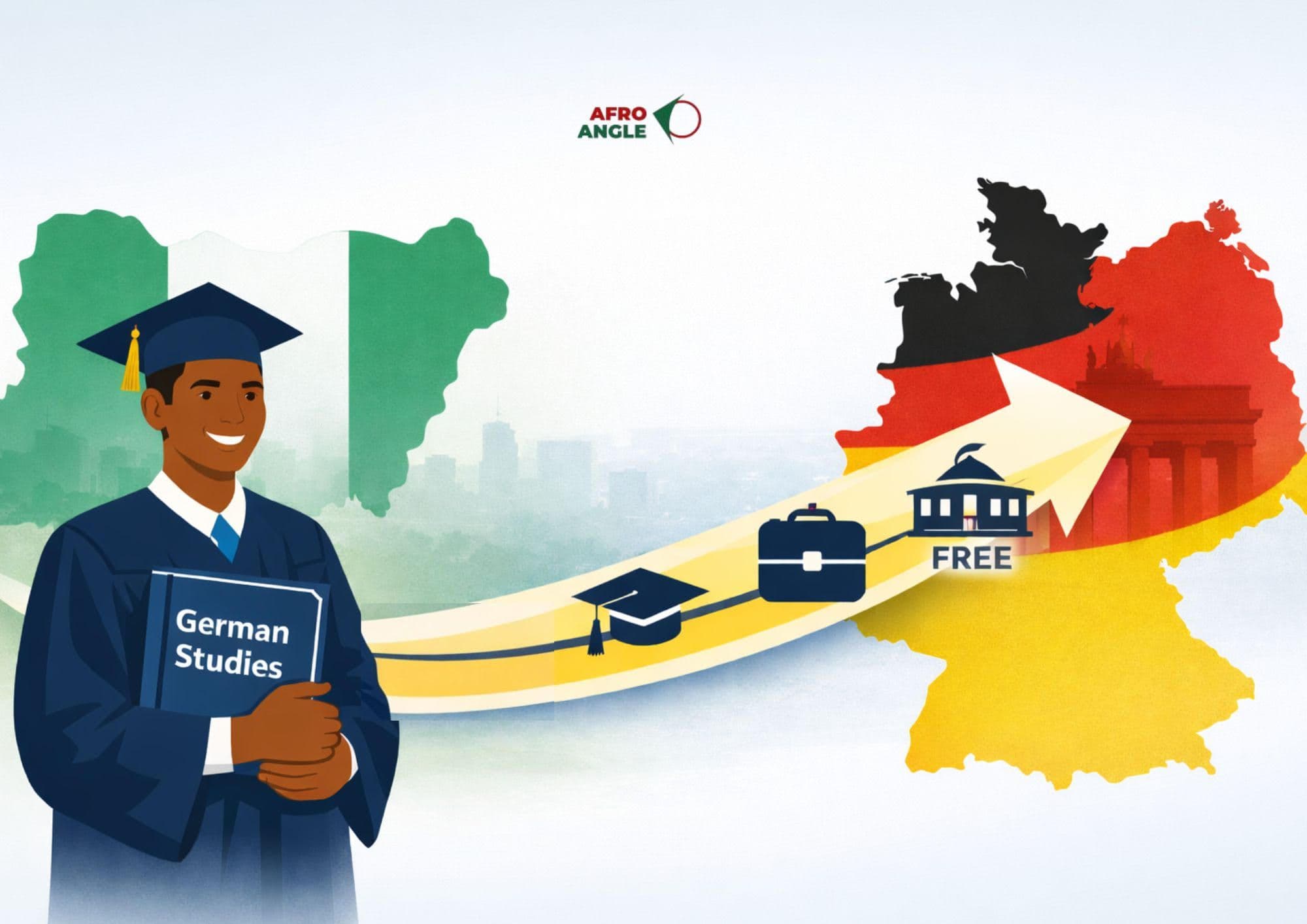
There are two main categories of Nigerians who access global opportunities through mastery of German language. The first group studies the language at the university. For them, scholarships such as DAAD Scholarships, Erasmus Mundus Joint Masters Degree Scholarship, and Konrad Adenauer Scholarships are the best pathways for securing mobility. These programs do not only facilitate international travel but also train participants in German culture and expose them to best practices from around the world, enabling them to contribute to national development at home.
A key example is Mr. Ibukunolu Ajagunna, who followed this path and returned to the University of Ibadan as a DAAD lecturer, serving from 2019 to 2023. Another person is Frau Anu Oloke, who heads the Language Department at the Goethe Institut in Lagos, Nigeria. Among this group are also many who work in the embassies and consulates of Germany, Austria, Switzerland, and Belgium as a result of their academic training.
The second group consists of skilled workers who enroll in language institutes and take proficiency examinations to prove their competence. Once certified, they apply for vocational training opportunities, which allow them to study, and upon the completion of the study, begin to work in Germany. This category earns first-hand experience in leading German companies while gaining a competitive economic advantage and meeting their financial needs.
Where are the Nigerians Benefiting from this Path?
Nigerians already maximizing the opportunities that mastery of the German language offers are hidden in plain sight. As a student of German studies at Obafemi Awolowo University, Ile-Ife, I spent a month at the Martin Luther University in Halle-Wittenberg on an immersion program sponsored by DAAD to boost my German competence.
This unique and life-changing experience enabled me to apply for a summer job in the United States of America, where I used my German proficiency in engaging with high school and middle school kids, as well as adults who come to the language camp for language immersion for three months. My experience reflects that of many students of German studies in Nigeria who attend all-expenses-paid annual summer programs in Germany to improve their oral proficiency.
Beyond short-term programs, another group of Nigerians is enjoying access to Germany's affordable public higher education. In Germany, higher education is tuition-free for both domestic and international students. Since students only pay a modest administrative fee, many Nigerians seize this opportunity to access advanced academic, scientific, and technological knowledge, which positions them as potential industry leaders in Nigeria and beyond. While Nigerians have complained for years about the declining quality of Nigerian education, German proficiency enables them to access opportunities abroad and position themselves to engineer long-term change at home.
What Would German Language Do for Nigeria?
German language has evolved from merely a language and disciplinary choice in universities to a pathway for young Nigerians to achieve international mobility, work in professional international contexts, and access quality, affordable education, currently limited at home.
Many people think that the desire of young people to leave Nigeria—either for studies or work—potentially weakens the cultivation of homegrown talent. However, counterarguments emphasize that talents in Nigeria have often been wasted due to the declining state of education and scarce professional opportunities rather than nurtured.
The international mobility of Nigerians and their access to quality education abroad thus offer potential for developing skilled individuals whose expertise can enhance Nigeria's development. This becomes evident when diaspora members are invited to participate in governance and reshape the country's socio-economic and developmental landscape.
Enoch Ayodele
Enoch Ayodele is a graduate student in German Studies at the University of Alabama, where he also serves as a Graduate Teaching Assistant in the Department of Modern Languages and Classics.
comments
No comments yet