
Insecurity Persists as Nigeria Moves to Decentralise Policing
by

Northern Nigeria: Security Situation Report (June 21 – June 27, 2026)
Introduction
The security landscape during this reporting period continues to reflect persistent armed group activity and sustained state counter-terrorism operations. Armed bandits continued to deploy explosive devices and landmines to impede offensive military operations while evading capture. In one incident in Bargaja, Isa Local Government Area of Sokoto State, an explosive device targeted security forces, killing two soldiers. In another incident, reportedly attributed to the Islamic State Sahel Province (ISSP), one person was attacked and an Nigeria Security and Civil Defence Corps (NSCDC) outpost was set on fire in Bagudo Local Government Area of Kebbi State.
Attacks against farmers also continued. Four farmers were killed and 11 abducted while working on their farms in Rabah Local Government Area of Sokoto State. In a similar incident, two farmers were killed on their farms in Gusau Local Government Area of Zamfara State.
These incidents reflect the continued exposure of farmers and farming communities to violence, which is impeding agricultural activities. Similarly, cattle rustling remained on the rise during the reporting period. Large-scale cattle rustling incidents were recorded across Kafur, Funtua, Malumfashi, and Bakori Local Government Areas of Katsina State. In one counter-terrorism operation, security forces recovered 120 rustled cattle in Chikun Local Government Area of Kaduna State as military offensive operations continued to expand across the region.
In a significant counter-terrorism development, the Minister of Interior stated that the deployment of the Central National Identity Database System, which is integrated with the databases of other security agencies, led to the arrest of top terrorist commanders at Katsina Airport as they returned from Mecca, Saudi Arabia.
While the arrests have been widely praised as a significant operational success, they have also raised concerns about how the suspects circumvented security screening during their departure and managed to bypass scrutiny associated with the pilgrimage process.
Furthermore, Nigeria enacted one of its most consequential constitutional amendments related to addressing insecurity with the establishment of state police. The new law grants state governments the authority to establish, recruit, train, and deploy their own police forces to address growing security challenges. While many have hailed the legislation as a significant step toward decentralising Nigeria's internal security architecture, credible concerns remain regarding the potential politicisation of state police, the concentration of coercive powers in the hands of state governors, funding sustainability, and whether the new policing structure can effectively address Nigeria's persistent security challenges.
Weekly Review
Data from the North-west region indicate an increase across all tracked security metrics during this reporting period compared with the previous week. Recorded incidents increased from 16 to 28, representing a 75% rise in the operational tempo of attacks. Fatalities also followed an upward trend, increasing from 50 to 67, a 34% increase that underscores the continued lethality of violence across the region. Likewise, abductions increased significantly, with 76 victims kidnapped compared to 41 in the previous week, representing an 85% increase. Taken together, these data indicate a renewed escalation in violence across the region and highlight the persistence of the security crisis.
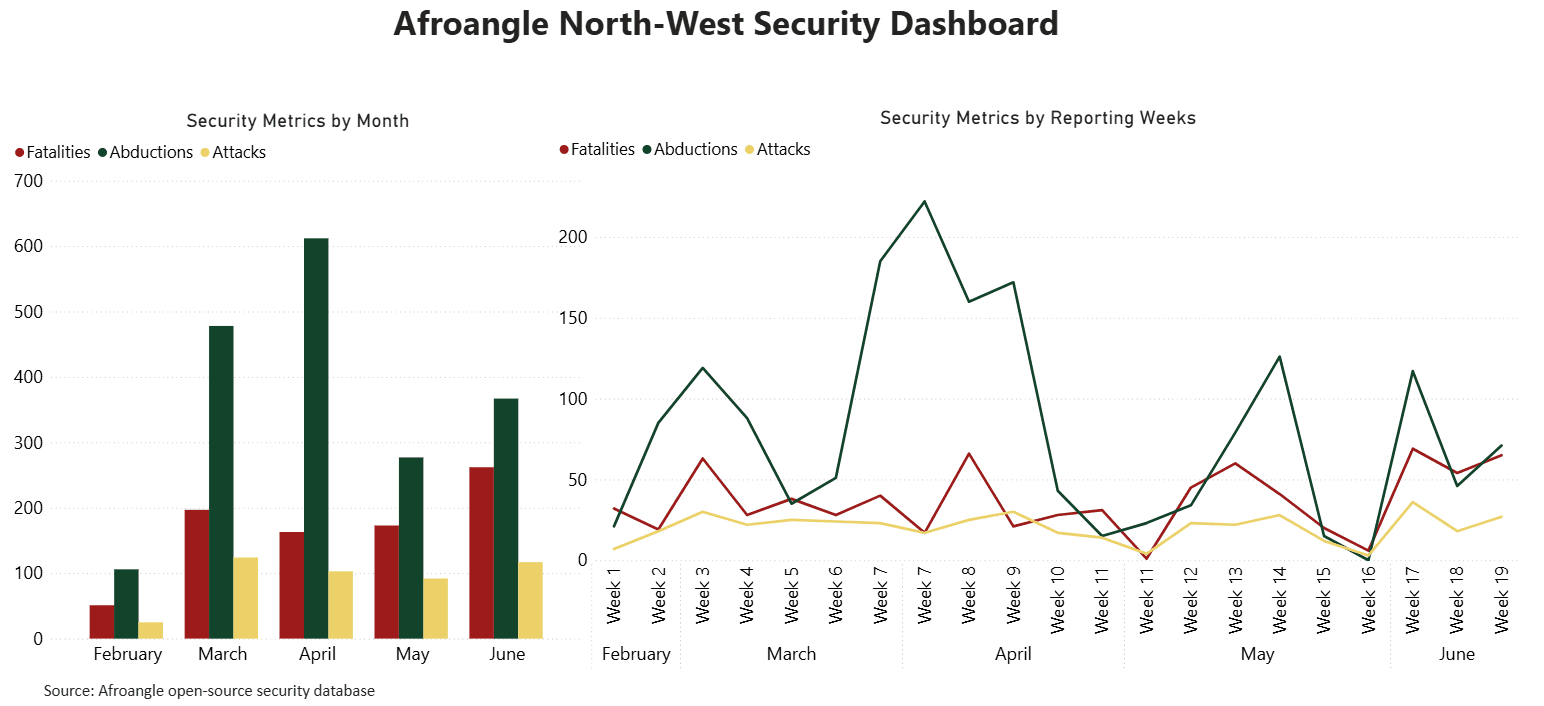
At the state level, Katsina, Zamfara, and Sokoto continued to dominate the security indicators. Katsina and Zamfara recorded the highest fatalities, with 25 and 22 deaths respectively. Sokoto recorded the highest number of abductions with 32 victims, followed by Zamfara with 23. Regarding incidents, Katsina recorded 12 attacks, while Zamfara recorded seven. These figures highlight both the geographic spread of insecurity and the sustained intensity of armed group activities across the North-west.
Analysis: State Police Bill Approved by the National Assembly
For almost two decades, Nigeria has grappled with multifaceted security challenges that have worsened in recent years. Throughout this period, the establishment of state police has remained one of the most prominent policy recommendations for addressing the country's internal security crisis. Proponents have consistently argued that state police would provide locally driven security responses, eliminate the bureaucratic and institutional bottlenecks associated with the centrally controlled Nigeria Police Force, and enable faster and more effective responses to emerging security threats.
Against this backdrop, the Nigerian Senate passed the State Police Bill on June 24, paving the way for the establishment of state police services across Nigeria's 36 states. The legislation comes at a critical time as Nigeria faces a deteriorating security environment, with violent threats expanding into areas that were previously insulated from widespread insecurity. Today, nearly every part of the country confronts one form of security challenge or another. The timing is also politically significant as Nigeria approaches the 2027 general elections. Consequently, the rapid passage of the bill provides the Tinubu administration with a major political achievement by advancing a long-debated reform that previous administrations either failed or declined to implement.
Nevertheless, several critical issues surrounding the bill will determine the long-term effectiveness and sustainability of state police services. The foremost concern centres on the potential misuse of state police by governors for political purposes, including intimidation and the persecution of political opponents. Although the bill prohibits state police commissioners from deploying officers against individuals or political parties except in accordance with the law, concerns remain that these legal safeguards could prove insufficient in practice.
Historical precedents, particularly the politicisation of State Independent Electoral Commissions, which often operate under the influence of state governors, have reinforced fears that similar political interference could affect state police. These concerns strengthen calls for more robust legal safeguards capable of preventing abuse, protecting operational independence, and limiting executive overreach.
A second concern relates to funding. State governments will bear primary responsibility for financing their respective police services through internally generated revenue and statutory allocations, while the federal government may provide financial support to states with limited fiscal capacity. However, estimates suggest that establishing state police services will require billions of naira, approximately ₦120 billion annually. This raises legitimate concerns about whether financially constrained states, many of which already struggle to fund essential sectors such as education and healthcare, will possess the resources necessary to sustain effective police services.
Finally, questions remain over whether state police alone can deliver lasting improvements in Nigeria's security environment. While decentralised policing is expected to increase personnel strength, improve local intelligence gathering, strengthen public trust, and enhance rapid response capabilities, it is unlikely to resolve Nigeria's security crisis unless governments simultaneously address the underlying drivers of insecurity, many of which vary across the country's regions.
The next stage of the constitutional process requires approval by state Houses of Assembly. This phase is likely to become one of Nigeria's most closely watched constitutional debates in recent years, and the response of individual states will determine both the future of state policing and the pace of its implementation.
Outlook
In the coming weeks, the northern operational theatres will likely continue to experience sustained violence alongside ongoing counter-terrorism operations. The North-west will remain particularly volatile, as bandit and insurgent groups continue to pursue territorial expansion and strengthen their influence across the region. At the same time, states across the country will begin the process of ratifying the State Police Bill. How quickly individual states move to adopt the legislation, and the nature of the debates surrounding its implementation, remain to be seen.
Similarly, attacks on farming communities will likely persist as armed groups continue to extort farming levies and assault rural communities. This trend will require a stronger and more coordinated government response to civilian protection, particularly across high-risk communities in Katsina and Zamfara states. Finally, security agencies should maintain heightened vigilance across the northern region, especially in the North-west, where the increasing use of improvised explosive devices (IEDs) by armed groups is likely to impede both security operations and civilian movement.
Afroangel Intel Admin
Afroangle Intel Admin
comments
No comments yet