
Is the People’s Democratic Party Dead?
by
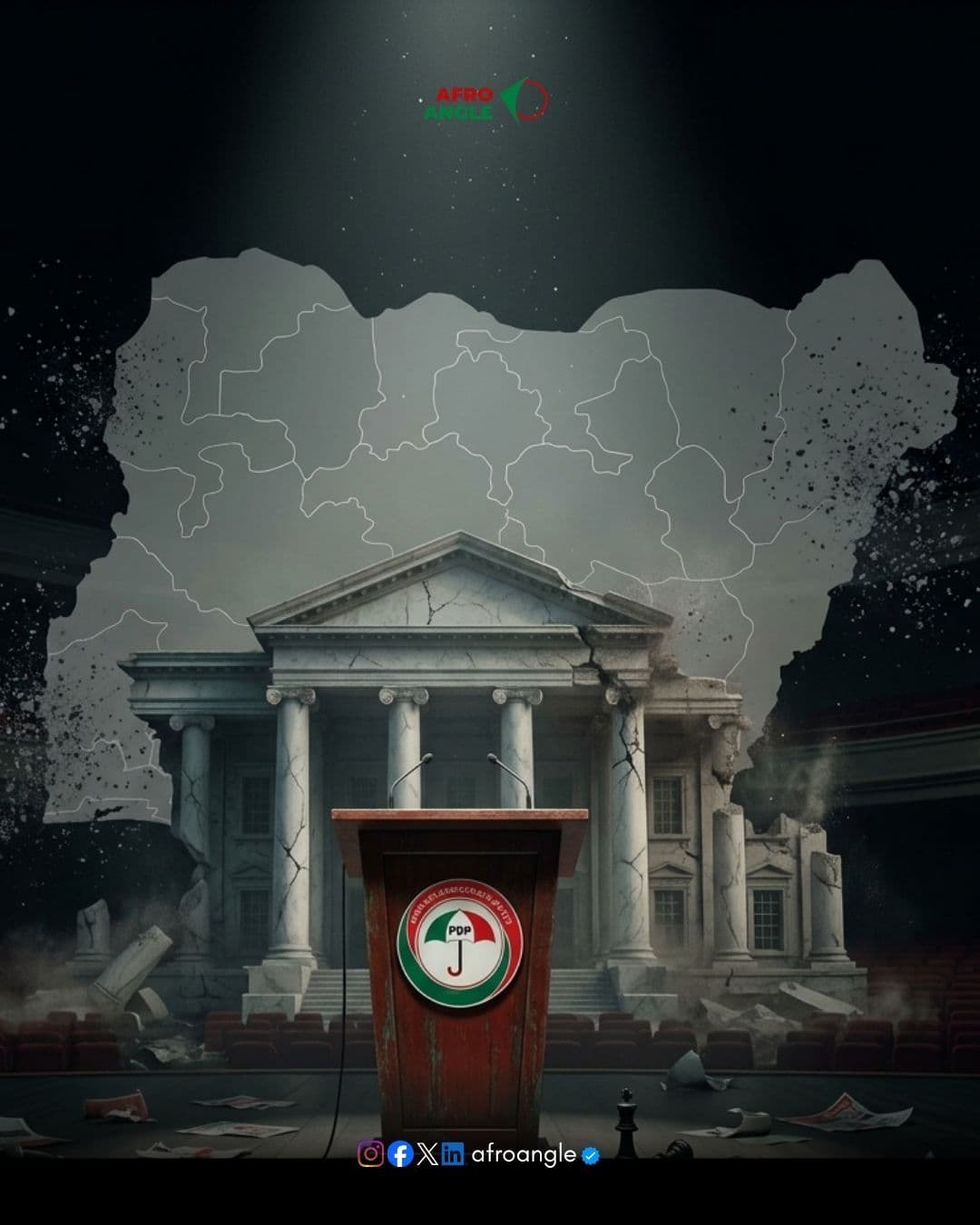
Formed in 1998 as Nigeria prepared its transition from military rule to civilian government, the People’s Democratic Party (PDP) dominated the Nigerian national political landscape for sixteen years without interruption. It held control of the presidency from 1999, at the dawn of Nigeria’s Fourth Republic till 2015. During this same period, it controlled the majority seats in the National Assembly and ruled most of the states of the federation. In its peak years, the PDP governed almost three-quarters of the states, so big to the extent that Vincent Ogbulafor, the party’s National Chairman in 2008, proudly asserted the party will rule Nigeria for the next 60 years.
However, the political tide shifted in 2015 when PDP, for the first time since the advent of the Fourth Republic, lost the presidency. Riding on the popular slogan of “Change,” the All Progressives Congress (APC) secured a historic victory with Muhammadu Buhari, whose campaign was carefully positioned as a repudiation of the perceived shortcomings of President Goodluck Jonathan’s administration. Today, however, the same party is confronting perhaps the deepest crisis in its history.
Years after losing federal power, PDP has been struggling with internal crisis, defections, and withering electoral influence. While the party’s defeat in 2015 marks a defining symbol of its decline, PDP’s current predicament is the aftermath of a much longer history of internal contradictions. The cracks that have now widened into deep fractures did not suddenly emerge after the party left power. Rather, they accumulated over several years, caused by unresolved leadership struggles, regional rivalries, zoning disputes and an increasing inability to manage competing political interests within its own ranks. The 2015 defeat only exposed weaknesses that had long existed beneath the surface.
To understand the current state of the PDP, one must return to one of the most significant moments in the party’s history: the death of President Umaru Musa Yar’Adua in May 2010. His passing created a political dilemma that tested the cohesion of the ruling party. Under Nigeria’s Constitution, then Vice President Goodluck Jonathan automatically assumed the presidency. Constitutionally, the succession was straightforward. Politically, however, it unsettled the delicate balance that had held the PDP together since 1999.
For years, the PDP had informally operated a zoning arrangement that alternated the presidency between the North and the South in an attempt to manage Nigeria’s complex ethnic and regional diversity. Yar’Adua, a northerner, had been expected to complete two terms before power would rotate to the South. His death midway through his first term disrupted that expectation. Jonathan’s decision to contest the 2011 presidential election, though constitutional, was interpreted by many influential northern politicians as a breach of the party’s unwritten power-sharing agreement.
The consequence evolved into a wider crisis within the party as several northern political heavyweights became alienated from Jonathan’s leadership. The PDP still won the 2011 presidential election convincingly, but beneath the electoral victory lay a growing resentment among influential stakeholders whose loyalty to the party had begun to weaken.
The warning signs became even more apparent in 2013 with the emergence of the “New PDP” (nPDP), arguably the most significant internal rebellion in the party’s history. Led by prominent governors like Rotimi Amaechi (Rivers), Abdulfatah Ahmed (Kwara), Rabiu Kwankwaso (Kano), Murtala Nyako (Adamawa), and Aliyu Wamakko (Sokoto) and supported by influential party leaders, the faction accused the party leadership of impunity, marginalisation and the concentration of power around President Jonathan and his allies. Rather than resolving the grievances through internal reconciliation, the dispute escalated into one of the biggest political defections Nigeria has witnessed.
The nPDP eventually aligned with other opposition parties, including the Action Congress of Nigeria (ACN), the Congress for Progressive Change (CPC), the All Nigeria Peoples Party (ANPP) and a faction of the All Progressives Grand Alliance (APGA), culminating in the formation of the All Progressives Congress. Ironically, many of the politicians who had once contributed to building the PDP became architects of the coalition that ultimately removed it from power.
The years that followed did little to reverse the decline. Instead of rebuilding after its first-ever electoral defeat, the PDP found itself trapped in recurring cycles of leadership disputes, convention controversies and factional struggles. Politicians who had remained within the party increasingly pursued competing personal ambitions.
The 2023 presidential election debacle also exposed the growing cracks within the PDP. The presidential primary that produced former Vice President Atiku Abubakar as the party’s candidate reopened old debates about zoning and power rotation. Many stakeholders believed that after President Muhammadu Buhari’s eight-year tenure as a northerner, the PDP should present a southern presidential candidate. Instead, Atiku, another northerner, emerged victorious at the party’s primary election. The controversy was compounded by the refusal of the party’s National Chairman, Iyorchia Ayu, himself from the North, to resign despite mounting calls from sections of the party that power should be balanced geographically.
The disagreement eventually produced one of the most damaging internal rebellions in the PDP’s recent history: the G5 governors led by Nyesom Wike. Alongside Seyi Makinde, Samuel Ortom, Okezie Ikpeazu and Ifeanyi Ugwuanyi, the group openly challenged the party leadership and insisted that Ayu should step aside before they would fully support the presidential campaign.
The internal tensions within PDP escalated drastically in 2025, as the party became increasingly divided between competing camps following the factional convention held in Ibadan. One faction gravitated toward Nyesom Wike, who is a member serving in President Bola Tinubu’s APC-led administration as Federal Capital Territory Minister, while another faction aligned with former minister Kabiru Tanimu Turaki.
The events that followed the 2023 elections suggested that the divisions exposed during the campaign were not temporary disagreements but symptoms of a deeper institutional crisis whose implications extended beyond electoral arithmetic.
PDP’s presidential votes dropped significantly from 2011 to 2023. In 2011, President Goodluck Jonathan got more than 22 million votes. In Jonathan's defeat to Buhari, the figures of his votes in 2015 had dropped to approximately 12.8 million. Atiku Abubakar received approximately 11.2 million votes in 2019 and the party's presidential performance in 2023 dipped further to less than seven million votes losing the seat to Bola Ahmed Tinubu of the APC. The PDP, at its peak, held control of over 28 states in the federation.
At the beginning of 2025, the PDP had 11 governors and before the end of the year, Plateau State Governor Caleb Mutfwang, Sheriff Oborevwori of Delta State, Umo Eno of Akwa Ibom State, Peter Mbah of Enugu, Ademola Adeleke of Osun State, Siminalayi Fubara of Rivers, Agbu Kefas of Taraba and Douye Diri of Bayelsa, all ditto for Ademola Adeleke, defected to the APC leaving the PDP with only four governors, Seyi Makinde of Oyo, Bala Mohammed of Bauchi, Dauda Lawal of Zamfara, and Ahmadu Fintiri of Adamawa. With the recent exit of its last two governors, Seyi Makinde and Bala Mohammed, into the Allied People’s Movement (APM), the party now finds itself without a single governor in the entire federation.
Beyond the governors, the trend also continued with lawmakers at the state and federal levels with many elected lawmakers defecting from the party. The trend heightened with the defection of influential members like its former flag bearers, Atiku Abubakar to the African Democratic Congress (ADC) and Ifeanyi Okowa to the APC.
Defections as a political phenomenon in Nigeria is a matter of strategy, rather than a matter of ideology. Politicians often make political decisions based on what they think will help them get power, influence and sustain their relevance. When the political party seems to be in trouble, defections tend to increase as politicians look for more secure options.
Since 2015, the PDP has been subjected to this reality over and over. Lawmakers, influential political figures and party stakeholders have either left the party or openly defied the party's leadership. In the case of informal defections, however, disagreements over coalition formation and future party coalitions have produced uncertainty about the party's unity ahead to 2027.
Opposition parties are important to every functioning democracy. The role of the opposition parties, aside from contesting elections, is to also hold governments to account and offer alternative policy options. They can also create a competitive political environment that can inhibit over-concentrated power. Such a potential decline in the strength of the PDP poses a concern that transcends the political party but the state of opposition in Nigeria.
Given that Nigeria's largest opposition group is in bad shape and there is no viable alternative in place, the nation faces the danger of a shift towards a more unequal electoral playing field. Under these circumstances, ruling parties could experience less institutional pressure, and citizens less options that can effectively challenge political officeholders. So the fall of the PDP is not a partisan affair, but a democratic one too.
Nonetheless, it may still be premature to declare the death of the party. Political parties in Nigeria rarely disappear completely. Instead, they reinvent themselves through coalitions, defections, and strategic realignments. Incidentally, the APC itself was born out of the amalgamation of opposition parties that were individually weak to challenge PDP's dominance.
The PDP still has a lot of political legs. It has national organisations, seasoned politicians, recognition and grassroot presence and support in multiple states. It is one of the few parties that has a national profile and legacy despite its rough times.
For the PDP, however, surviving will no longer be sufficient. Perhaps the more pressing question for the party is how it can change its image, re-establish a level of internal solidarity and restore confidence in it as a potential opposition party. If the party does not manage to overcome its leadership wrangles and institutional divisions, it can lose relevance irrespective of its actual status. The PDP's current trajectory does not necessarily imply collapse, but rather a gradual loss of political control. It is a symbolic loss for a party which once thought of ruling Nigeria for, at least, 60 years.
The big question now is not whether PDP can return to power in the coming years. Instead, it is whether Nigeria’s democracy can continue to be vibrant without a strong, stable and consistent opposition that can provide a meaningful political competition.
Olanshile Ogunrinu
Olanshile Ogunrinu is a Nigerian freelance journalist and graduate of Communication and Language Arts from the University of Ibadan. His works have appeared in notable local and international media platforms, where he reports on education, governance, politics, and human rights. He is interested in public-interest journalism, social justice, and accountability reporting, using storytelling to amplify underrepresented voices and contribute to informed public discourse.
comments
No comments yet