
Niger Coup Attempt: Key Developments and Strategic Implications
by

What Really Happened?
On 28–29 August 2026, Niger witnessed a violent uprising that directly challenged the stability and political control of the Tchiani-led government. A faction of the Nigerien military reportedly attempted a coup or mutiny against the ruling junta, launching attacks against key state infrastructure, including Air Base 101, the presidential palace and the state television headquarters. While the precise objective of the group remains unclear and the situation has since stabilised, the choice of targets points towards an attempt to seize or disrupt the institutions and infrastructure that are central to regime control, potentially a coup attempt. These are also the same types of strategic locations targeted when the Tchiani-led junta seized power in 2023.
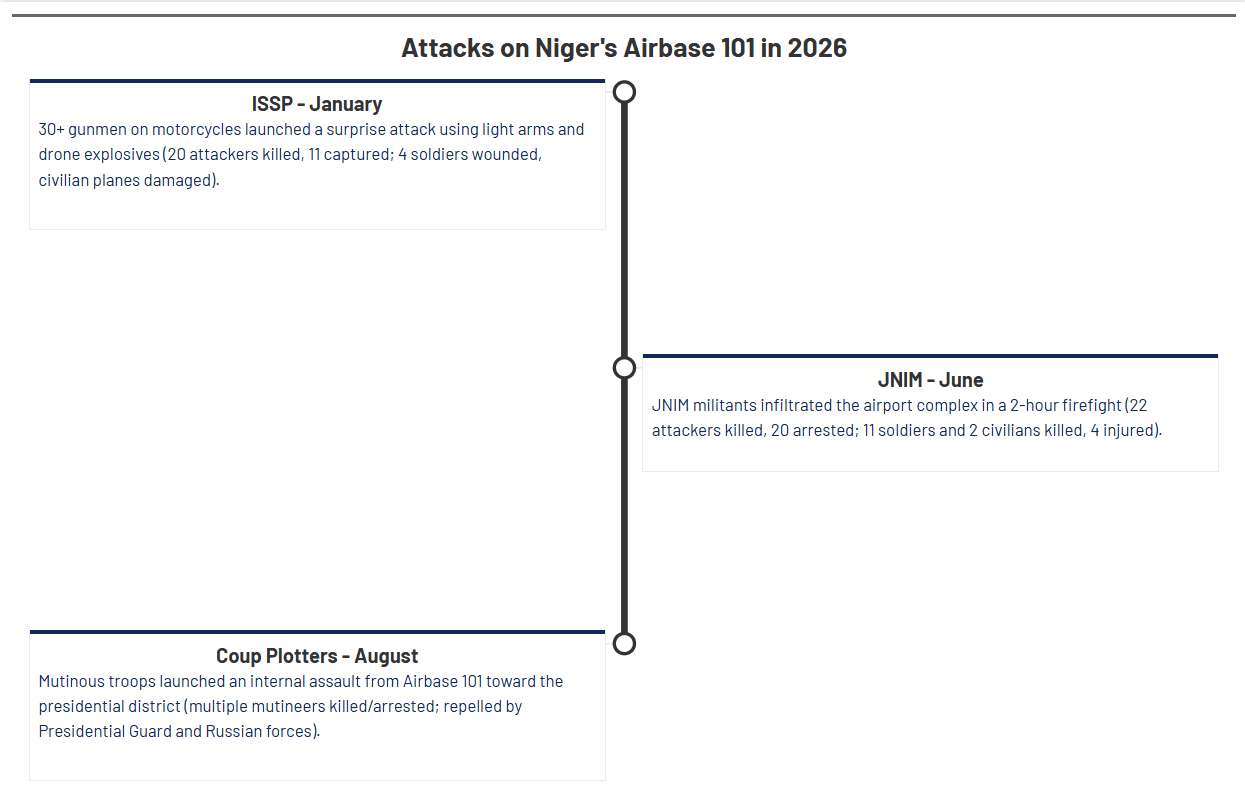
The targeting of Air Base 101 is particularly significant, because of what it represents. The base hosts the headquarters of the Alliance of Sahel States (AES) forces and has also been used by Russia’s Africa Corps and other foreign military personnel. It has now been targeted on three occasions, including previous attacks attributed to IS-Sahel and JNIM. The latest incident therefore highlights both the strategic importance and vulnerability of the facility.
Beyond its military function, it is closely tied to the security architecture protecting the junta, meaning that an attack on the base is effectively an attempt to strike at the heart of the regime’s security structure. The situation surrounding the uprising remains fluid, with reports of arrests and an internal military purge, as well as allegations of external involvement. This assessment examines the main developments and what they could mean for Niger’s political stability, security environment, regional alliances and wider geopolitical position.
Key Developments
1. Containment
The junta appears to have contained the immediate threat, but the reported deaths of presidential guards point to the seriousness of the confrontation. At least three members of the presidential guard were reportedly killed during the confrontation, although some conflicting reports suggest the number could be higher. However, the junta's ability to regain control relatively quickly is important because it allows the government to present the uprising as contained and demonstrate that it retains command over the security establishment. However, the fact that armed elements were able to challenge strategic installations in the capital suggests that the regime's control is not as consolidated as its public messaging may suggest.
2. Reported Mutiny within Troops
The reported involvement of frontline troops points to a possible link between military dissatisfaction and the deteriorating security situation. Unconfirmed reports suggest that some of the alleged plotters came from units operating in Tillabéri and Dosso, two regions heavily affected by jihadist violence. If confirmed, this would be significant because it would suggest that dissatisfaction is emerging from within the forces directly exposed to the country's deteriorating security situation. Reports that the government's decision to release detained JNIM members may have contributed to resentment among some frontline personnel would further indicate a growing gap between the junta's political calculations and the perceptions of soldiers fighting the insurgency. This remains unconfirmed, but if the pattern is established, it could become a major source of internal instability.
3. Third Party Actor Involvement
Russia's Africa Corps moved beyond its traditional advisory role and reportedly played a direct role in suppressing the uprising. The Africa Corps reportedly participated in the response, a role subsequently acknowledged by the Russian Ministry of Defence. The reported use of kamikaze drones during the counter-operation also indicates the level of force deployed to contain the threat. This is significant for the future of Russia-Niger security relations. Until now, Russia's role in Niger has largely centred on military training, intelligence and advisory support. Its involvement in the latest crisis could mark a shift towards a more direct regime-protection role, similar to the broader role Russia has assumed in Mali, Burkina Faso and Central Africa republic.
4. Internal Purge
The reported purge within the military could strengthen regime control in the short term while deepening internal divisions. Unconfirmed open-source reports indicate that Nigerien authorities have arrested and disarmed several members of the security forces in the Bankilaré department of Tillabéri, including a lieutenant colonel reportedly serving as the head of operations in the area and his deputy. Similar reports have emerged from the Diffa region.
If confirmed, these measures would likely form part of a broader effort to identify suspected collaborators and remove potential threats within the security establishment. The immediate objective would be to consolidate the junta's control and ensure greater loyalty across the military. However, extensive purges could also deepen resentment among officers and frontline troops, particularly if the underlying grievances around insecurity and internal resentment remain unresolved.
5. Algeria’s Support to the Junta
Algeria's deployment of military aircraft signals the strategic importance it attaches to regime stability in Niger. In an unusual show of support, Algeria reportedly deployed four fighter jets and other aircraft assets in support of the Nigerien government. Beyond the immediate security dimension, the move allows Algiers to demonstrate that it remains a reliable regional partner for Niamey. Algeria shares a long border with Niger and has increasingly strengthened its political and economic relationship with the junta. A destabilised Niger would therefore create direct security risks for Algeria while also undermining the influence it has worked to build with the AES states. The deployment can consequently be viewed as both a show of support for the Nigerien regime and an attempt by Algeria to protect its growing strategic interests in the country.
Strategic Implications:
The attempted uprising raises questions about how sustainable the junta's control will be as insecurity continues to deteriorate. The reported resentment among some frontline forces is particularly important. Niger's security situation has worsened significantly, with the Global Terrorism Index reporting a sharp increase in terrorism-related impact. If soldiers operating in the most affected areas increasingly perceive that the government's strategy is failing, dissatisfaction could develop into a broader challenge to military cohesion.
This would create a difficult dilemma for the junta. The immediate response is likely to involve greater investment in regime protection, including the deployment of loyalist forces, tighter monitoring of military personnel and further purges. These measures may reduce the likelihood of another coup attempt in the short term, but they could also divert political attention and resources away from the insurgency. More importantly, if frontline troops continue to suffer casualties while believing that political decisions are weakening their position, removing individual officers will not resolve the underlying grievance.
Russia's role is likely to become more important as a result of the crisis. The direct involvement of the Africa Corps demonstrates that Moscow can provide the junta with an external security guarantee when its own forces face an internal threat. This could encourage Niamey to rely more heavily on Russia for regime protection and potentially expand the Africa Corps' responsibilities beyond training and advisory functions. It may also give Russia greater influence over Niger's security architecture, particularly if the junta increasingly views the Africa Corps as a dependable partner during periods of political instability.
On the other hand, Algeria's response carries a different strategic significance. Its show of force demonstrates that Algeria is increasingly willing to become directly involved in protecting its interests in the Sahel. Despite previous tensions between Algiers and the AES governments, Algeria cannot afford a destabilised Niger along its southern border. The deployment therefore reinforces the growing rapprochement between the two countries while allowing Algeria to position itself as an important security partner for the junta.
The main beneficiaries of the crisis could ultimately be the jihadist groups operating across Niger. Any weakening of cohesion within the military, combined with the diversion of resources towards regime protection, could create additional space for groups such as JNIM and IS-Sahel to expand their activities. A weakened command structure could also reduce the effectiveness of military operations in Tillabéri, Dosso, Tahouna and other high-risk areas. At the same time, if the junta responds primarily through repression and internal purges without addressing the concerns of frontline personnel, the same grievances that contributed to the uprising could deepen among both soldiers and civilians.
The attempted coup therefore exposes a wider structural problem for the Tchiani government. The junta may retain strong control over the capital and the institutions around Niamey, but the events suggest that this control does not necessarily extend with the same strength to the wider security establishment. If the government continues to face growing insecurity outside the capital while concentrating increasingly on regime protection inside it, the gap between political control and territorial control could become more pronounced.
Outlook
Niger is therefore entering a critical period. The immediate uprising has been contained, but the underlying drivers of instability remain. The military purge may strengthen the junta's control in the short term, while Russia and Algeria are likely to deepen their security engagement with Niamey. However, unless the government can also address the deteriorating security situation and the grievances emerging among frontline forces, another internal challenge cannot be ruled out. The aftermath of this attempted uprising will therefore be important in determining whether the junta emerges more consolidated or increasingly dependent on loyalist forces and external partners to maintain its hold on power.
Afroangel Intel Admin
Afroangle Intel Admin
comments
No comments yet