
Assessing Mali-Algeria Rapprochement: Drivers, Strategic ambition and regional stability.
by

Assessing Mali-Algeria Rapprochement: Drivers, Strategic ambition and regional stability.
In an unprecedented turn of events in the Sahel, Algeria and Mali have decided to restore diplomatic ties and normalize relations, concluding a year-long standoff and severe bilateral tensions. This diplomatic fracture initially began in April 2025, when Algeria downed a Malian surveillance drone that Algiers claimed had violated its airspace, leading to a swift severing of formal ties between the two neighbors. The rupture resonated across the wider region, drawing sharp reactions from the Alliance of Sahel States (AES); in solidarity with Mali, fellow member states Burkina Faso and Niger also withdrew their diplomatic representation, further deepening the regional divide with Algiers.
Historically, Algeria has served as a critical regional neighbor and strategic ally to Bamako, frequently mediating peace accords between the Malian government and northern Tuareg rebel factions, including the 2015 peace deal. However, during this recent period of diplomatic isolation, Mali’s security landscape shifted drastically, serving as the primary catalyst for the current rapprochement. Over the past few months, armed groups operating across Mali have posed an increasingly existential threat to Malian sovereignty. Their expanding operational capabilities have simultaneously begun to jeopardize Algeria's own national security interests along its southern border.
This renewal of diplomatic ties has prompted the return of ambassadors to their respective posts, the reopening of bilateral airspace to both civil and military aviation, and, most crucially, the restoration of intelligence-sharing channels. This renewed security communication is highly significant as Mali continues to confront an escalating threat from a sophisticated convergence of armed actors. Ultimately, this assessment explores the strategic drivers behind this diplomatic restoration and evaluates what this alignment portends for the near-term security of both Mali and Algeria as Sahelian stability remains under profound strain.
Strategic Drivers Behind the Rapprochement
A primary catalyst for this diplomatic normalization is the escalating threat to the national security of both nations, driven by the increasing sophistication of Jama'at Nusrat al-Islam wal-Muslimin (JNIM) and its tactical alliance with Tuareg rebels. In April 2026, a coordinated coalition of JNIM and the Front de Libération de l'Azawad (FLA) executed simultaneous, large-scale offensives across multiple theaters. These assaults spanned from northern strongholds in Kidal and Gao to central hubs in Ségou and Sévaré, ultimately penetrating southern locations including Kati and the capital, Bamako.
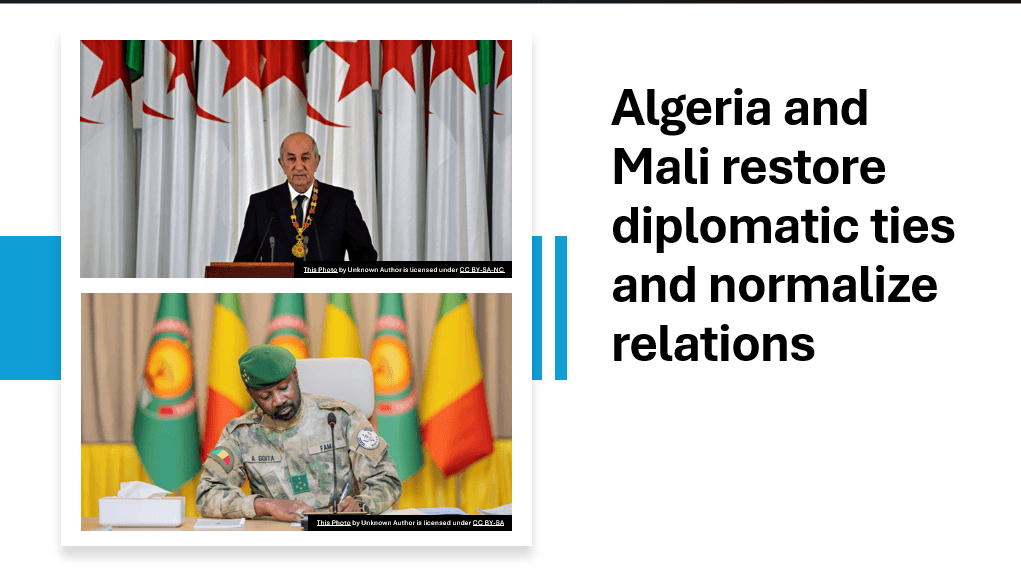
The offensive struck the core of the ruling military regime, resulting in the death of the Defense Minister and directly targeting the residence of Mali's transition president, Assimi Goïta. This operation yielded total rebel control over Kidal and left parts of Gao contested between the JNIM-FLA coalition and Malian government forces. Crucially, this campaign marked the first instance of direct operational coordination between JNIM and Tuareg separatist factions. Since then, this joint cooperation has redefined Mali's threat landscape, characterized by continuous combined operations against state forces.
This momentum persisted into early July 2026, when both groups launched another series of synchronized assaults targeting Gao, Sévaré, Konna, and Aguelhok. From the strategic viewpoint of the Malian junta, the enduring alliance between JNIM and the FLA represents an existential threat to state sovereignty and long-term stability. This reality necessitated a diplomatic pivot toward a neighbor with deep historical ties to the Tuareg communities and a vested national security interest in preventing extremist expansion along its southern border. From Bamako's perspective, normalized relations with Algiers could facilitate robust security partnerships and joint border operations to contain these armed groups. Alternatively, leveraging Algeria's historical mediation role could allow Algiers to exert diplomatic pressure on Tuareg factions, potentially fracturing the alliance between the nationalist rebels and JNIM.
Conversely, from Algiers' perspective, the rapprochement represents a strategic effort to reassert and expand its regional influence across the Sahel. Prior to this normalization with Mali, Algeria had already begun rebuilding diplomatic bridges with other Alliance of Sahel States (AES) members, notably Niger and Burkina Faso. In mid-February, a high-profile state visit by the Nigerien president to Algiers concluded with the re-establishment of formal diplomatic ties, the signing of a comprehensive security agreement, and a commitment to revitalize the Trans-Saharan Gas Pipeline, a vital economic corridor for the Sahel. Similarly, Algeria initiated a gradual diplomatic re-engagement with Burkina Faso. This effort was marked by high-level bilateral visits and Algiers' announcement of an $88 million investment in Burkina Faso's mining and energy sectors. Collectively, these initiatives form a broader Algerian strategy to expand its footprint in the Sahel, maintain bordering stability, and counter regional rivals, such as Morocco.
Strategic Outlook and Regional Implications
The diplomatic thaw between Mali and Algeria has the potential to aid in containing the expanding capabilities of regional armed groups, and offering tactical advantages to state actors across the Sahel. For Mali, the restoration of bilateral intelligence-sharing and security coordination could prove vital in disrupting and thwarting the sophisticated JNIM-FLA threat, which has heavily strained state forces. This security pivot may lead to joint border patrols and the potential reactivation of the Joint Operational General Staff Committee (CEMOC), a multilateral counter-terrorism and organized crime framework comprising Mali, Algeria, Niger, and Mauritania.
For Algeria, normalization could unlock significant economic opportunities, particularly regarding logistics and infrastructure projects along the Trans-Saharan transport corridor connecting Mali to Algerian maritime ports. This transport route would also benefit landlocked Mali, which faces continuous disruptions along its critical economic corridors.
Furthermore, despite the Malian junta's current hardline stance against negotiations with Tuareg rebels, Algiers could eventually leverage its traditional mediation role to establish channels of communication with rebel factions still receptive to state engagement. Finally, this rapprochement advances Algeria's goal of reclaiming its position as a primary geopolitical arbiter in the Sahel. Ultimately, while the normalization of ties between Mali and Algeria is a highly significant development amid an increasingly volatile Sahelian security environment, the long-term impact of this détente, and its broader integration with other AES states like Niger and Burkina Faso, on the regional security architecture remains to be seen.
Afroangel Intel Admin
Afroangle Intel Admin
comments
No comments yet