
Assessing the State of AI Governance in Nigeria
by

Listen to this article
Assessing the State of AI Governance in Nigeria
Introduction
Artificial intelligence has moved far beyond discussions about future possibilities. Across Nigeria, AI systems already influence how businesses operate, how citizens access information, how financial institutions assess risk, and how public institutions think about service delivery and security. What was once viewed as an emerging technology has become part of everyday economic and social activity.
The pace of adoption of AI in Nigeria has been particularly notable over the last few years. Businesses increasingly use AI to automate processes, improve productivity, and reduce operational costs. Government institutions have begun exploring its application in public administration, security, and digital governance. At the individual level, the widespread availability of generative AI tools has expanded access to information, content creation, and digital entrepreneurship.
Yet while adoption continues to accelerate, governance has not developed at the same pace. Existing regulatory instruments address certain aspects of data protection, cybersecurity, and digital governance, but they do not provide a comprehensive framework for managing the opportunities and risks associated with AI. Consequently, a growing gap has emerged between the deployment of AI systems and the institutions responsible for overseeing them.
This gap matters because AI is no longer confined to technology companies. It increasingly shapes decisions affecting privacy, public trust, economic opportunity, national security, and the integrity of the information environment. As deployment expands across sectors, the absence of clear governance mechanisms will become increasingly difficult to ignore.
Use of AI in Nigeria
AI adoption in Nigeria has expanded across both the public and private sectors, although the pace and sophistication of deployment vary considerably.
Government
Within the government, efforts to position Nigeria as a regional player in AI development have gained momentum. The National Artificial Intelligence Strategy provides a broad framework for developing the country's AI ecosystem, while the National Centre for Artificial Intelligence and Robotics (NCAIR) supports research, innovation, and skills development. Federal initiatives increasingly focus on building local talent, supporting startups, and integrating emerging technologies into broader digital transformation efforts.
Banking Institution and FinTech
The most visible growth has occurred within the private sector. Nigeria's fintech industry has become one of the largest adopters of AI technologies. Financial institutions and digital payment platforms increasingly use machine learning tools to detect fraudulent transactions, assess creditworthiness, automate customer support, and strengthen anti-money laundering compliance. These capabilities have become particularly important as digital transactions continue to grow across the country.
Agriculture
Agriculture has also witnessed a gradual expansion in AI adoption. Technology firms now deploy AI-enabled tools for crop monitoring, weather forecasting, yield prediction, and pest detection. While large-scale deployment remains limited, these technologies have the potential to improve productivity and strengthen resilience in a sector that remains vulnerable to climate-related disruptions.
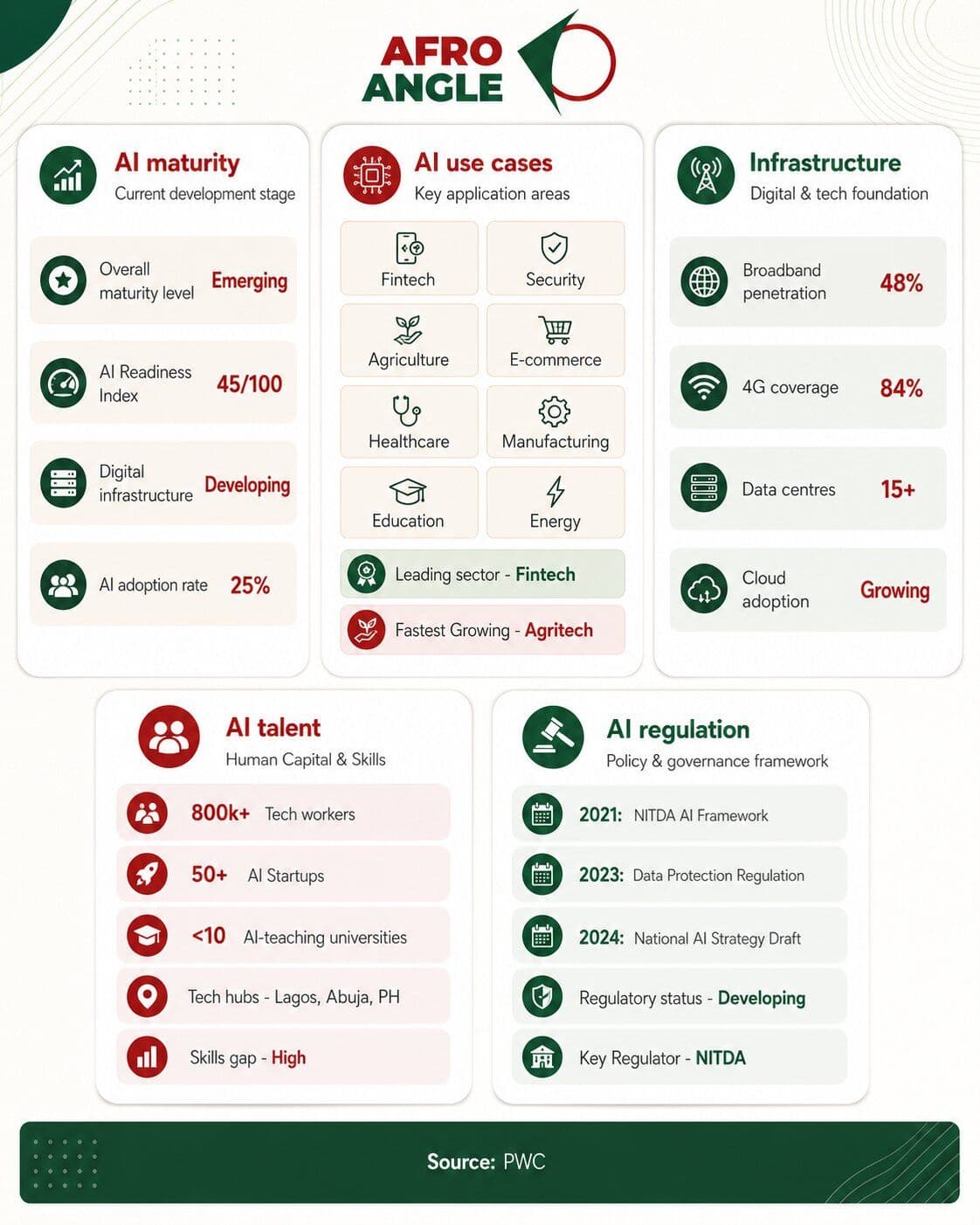
AI’s ecosystem in Nigeria
Healthcare and E-commerce
In healthcare, AI applications support diagnostics, disease surveillance, telemedicine, and health data analysis. Educational institutions increasingly use AI-powered learning platforms to support teaching and personalized learning. E-commerce companies rely on recommendation systems, predictive analytics, and automated customer engagement tools to improve service delivery and consumer retention.
Security
The security sector presents another important area of deployment. Several state governments and urban authorities have invested in AI-enabled surveillance systems, including intelligent CCTV networks and facial recognition technologies. Security agencies increasingly view these tools as force multipliers capable of improving monitoring, crime detection, and situational awareness. However, their expansion has also generated concerns regarding privacy protections, data governance, and oversight mechanisms. For example, there has been a rise in AI-generated videos and pictures attempting to depict attack and kidnapping incidents, which have blurred the lines between what is real and what is not, creating confusions among the population for clicks on social media.
Beyond these formal sectors, AI has become deeply embedded within Nigeria's digital ecosystem. Content creators, journalists, researchers, students, and entrepreneurs increasingly rely on AI tools to generate content, conduct research, and improve productivity. At the same time, the technology has lowered the barriers for producing misinformation, manipulating media, and conducting online influence operations.
This duality defines much of Nigeria's current AI landscape. The same technology that drives innovation and efficiency can also amplify existing vulnerabilities within the information environment. Deepfakes, AI-generated propaganda, synthetic media, cyber-enabled fraud, and technology-facilitated abuse increasingly feature in discussions about digital safety. Women and girls remain particularly vulnerable to several of these risks, especially non-consensual image manipulation and targeted online harassment. Taken together, these developments suggest that AI adoption is no longer a future policy issue. It is already shaping economic activity, governance, security, and public discourse.
AI Governance in Nigeria: Regulatory Gaps and Areas for Improvement
Despite growing adoption, Nigeria's governance architecture remains fragmented. The country has developed several policies and regulatory instruments that intersect with AI. The Nigeria Data Protection Act provides an important foundation for privacy and data governance. The National Digital Economy Policy and Strategy outlines broader digital transformation objectives. Similarly, institutions such as NITDA, the Nigeria Data Protection Commission, the NCC, and NCAIR all play roles in shaping different aspects of the digital ecosystem.
Institutional fragmentation
The challenge is that these institutions were not created specifically to govern artificial intelligence. As a result, responsibility for AI-related issues remains spread across multiple agencies with overlapping mandates. Questions surrounding algorithmic accountability, transparency, automated decision-making, and AI-related harm often fall into regulatory grey areas. While several institutions possess partial authority over components of the AI ecosystem, no single body currently provides comprehensive oversight.
This institutional fragmentation becomes more problematic as AI systems move into high-risk sectors.
In healthcare, regulators will increasingly need standards governing AI-assisted diagnostics, clinical decision-making, and patient safety. Within telecommunications, oversight mechanisms must address how AI influences consumer protection, data usage, and network management. In the security sector, the growing use of facial recognition, predictive analytics, and surveillance technologies raises difficult questions regarding privacy, illegal surveillance and accountability.
Weakened regulatory frameworks
The digital information environment presents an equally significant challenge. Existing regulatory frameworks struggle to address AI-generated misinformation, synthetic media, deepfakes, and coordinated online manipulation. As generative AI tools become more accessible and sophisticated, distinguishing authentic content from fabricated material will become increasingly difficult for both regulators and the public. This is particularly concerning as Nigeria heads towards a critical electoral period, where they are growing concerned about the deployment and use of these tools for electoral misinformation.
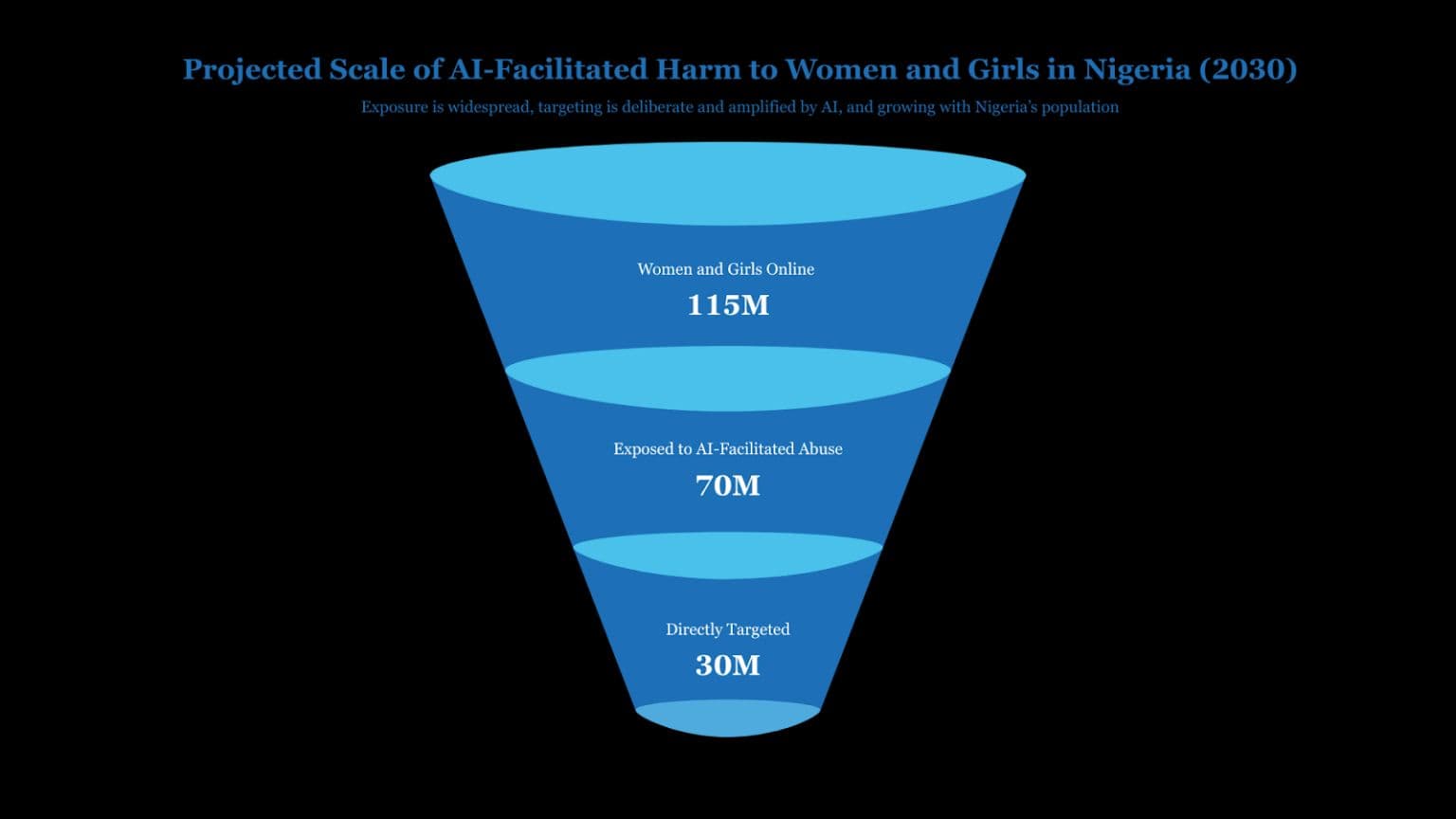
Gatefield’s assessment of AI facilitated harm to Women and girls
Towards a Secure AI Environment
Addressing these gaps requires more than a broad policy statement. Nigeria needs a governance framework that reflects how AI is actually being deployed across different sectors.
- A useful starting point would be the establishment of a central coordinating mechanism, whether through a National AI Commission or a dedicated interagency framework. Such a structure would help reduce institutional overlap, improve policy coordination, and clarify regulatory responsibilities.
- Equally important is the adoption of a risk-based approach to regulation. Not all AI systems carry the same level of risk. Applications used in healthcare, national security, elections, law enforcement, and critical infrastructure should face stricter oversight requirements than lower-risk commercial applications. Such an approach would balance innovation with accountability rather than treating all AI systems equally.
- Sector-specific governance will also become increasingly important. Healthcare regulators should establish standards for clinical validation and patient safety. Telecommunications regulators should address AI-related consumer protection concerns. Security agencies require clear legal frameworks governing surveillance technologies and facial recognition systems. Likewise, policymakers must develop mechanisms for addressing deepfakes, synthetic media, and AI-enabled information manipulation.
Nigeria should also ensure that its governance framework aligns with emerging international standards, including initiatives developed by the African Union, UNESCO, and other multilateral institutions. However, any framework must reflect local realities rather than simply replicate foreign regulatory models. Nigeria's digital economy, security environment, and governance challenges differ significantly from those of Europe, North America, or East Asia. The objective should not be to slow AI adoption. Rather, it should be to ensure that technological deployment occurs within a framework that protects citizens, strengthens accountability, and supports innovation.
Conclusion
Nigeria's AI ecosystem is expanding far more rapidly than the institutions responsible for governing it. Government agencies, private companies, security actors, and ordinary citizens increasingly rely on AI systems, yet regulatory oversight remains fragmented and incomplete.
This imbalance is likely to become more pronounced as AI applications move deeper into critical sectors such as healthcare, telecommunications, security, finance, and public administration. Without clear governance mechanisms, the risks associated with privacy breaches, misinformation, algorithmic bias, and unchecked surveillance will continue to grow alongside the technology itself.
The policy challenge facing Nigeria is therefore not whether artificial intelligence should become part of the country's development trajectory. That process is already underway. The more immediate challenge is building the institutions, safeguards, and regulatory frameworks capable of managing its consequences. Until that gap narrows, AI adoption will continue to outpace AI governance.
Adam Abass
Adam Abass is a graduate student of political science and international relations. His research focuses on Middle Eastern politics, counter-terrorism, peace, and security in Africa.
comments
No comments yet