
How African Militaries are Adopting and Integrating Artificial Intelligence into Military and Defence Strategy
by

Overview
Artificial Intelligence is rapidly reshaping modern warfare. Once viewed as an emerging technology, AI now underpins intelligence collection, battlefield decision-making, autonomous systems, logistics, and military planning across many of the world's leading armed forces. From Ukraine and Gaza to the recent U.S. strikes against Iran, AI-enabled capabilities are increasingly influencing how militaries detect threats, process intelligence, and conduct operations. While major military powers continue investing heavily in these capabilities, African militaries have received far less attention. Yet the continent's evolving security environment, characterised by highly mobile insurgent networks, vast ungoverned spaces, and increasingly sophisticated armed groups, raises an important question: how far has Africa progressed in integrating AI into its defence strategy, and are current investments aligned with the threats it faces?
State of Adoption
African militaries are no longer absent from the global AI race. Adoption has accelerated in recent years, although it remains concentrated in a limited number of operational functions rather than across the full military enterprise. Most investments focus on intelligence, surveillance, logistics, and border security, while more advanced applications such as AI-enabled command systems, autonomous targeting, and battlefield decision support remain largely underdeveloped. In particular, AI integration has focused on intelligence and surveillance, especially through AI-enabled drones used to monitor difficult terrain and porous borders. This has been demonstrated along Kenya's border with Somalia, where AI-enabled drones monitor volatile border corridors against Al-Shabaab incursions. These AI systems have also proven effective in predictive maintenance and logistics optimisation by analysing equipment data to detect failures in critical assets and improve supply chain efficiency.
These logistics optimisation systems also incorporate machine learning models that help extend the lifespan of military assets such as armoured vehicles and aircraft. Egypt is among the leading adopters of these technologies, using AI to monitor fighter jet engine performance and reportedly reducing unforeseen maintenance requirements by up to 30%. Algeria also employs AI models to maintain its tank fleet and turret systems based on operational data collected during desert deployments. Alongside this, AI-enabled systems are increasingly being used to strengthen border security through facial recognition and anomaly detection to identify potential terrorist threats and affiliated individuals. Morocco has been at the forefront of deploying these technologies in North Africa.
One of the most significant developments has been the emergence of autonomous weapons. Although only one widely reported autonomous drone incident has occurred on the continent, it is regarded as the world's first documented use of an autonomous weapon system. The incident occurred in Libya in 2020, where an autonomous drone reportedly engaged targets with minimal human oversight. AI has also been integrated into multi-domain national security intelligence platforms that combine intelligence, surveillance, and operational data into a single command environment. Nigeria's engagement with MARSS UK to deploy an AI-enabled Command, Control, Communications, Computers, and Intelligence (C4I) infrastructure illustrates the growing recognition among African states of the importance of integrating these technologies into national security frameworks.
The growing interest in AI extends beyond operational deployment. There is also increasing recognition of the need for research and development focused on AI technologies tailored to Africa's unique conflict dynamics and national security challenges. South Africa's establishment of an AI institute dedicated to the defence and military sector reflects this growing emphasis. While Africa's overall integration of AI into national security could arguably be estimated at around 20–25% compared to the global pace of adoption, current efforts remain concentrated in areas such as AI-powered drones, logistics, and multi-domain intelligence platforms. Much less attention has been given to several core AI capabilities that are increasingly necessary given the nature of the continent's evolving security threats, particularly across Sub-Saharan Africa.
Africa's AI Defence Gaps
The continent's principal AI capability gaps lie in intelligence, surveillance and reconnaissance (ISR), advanced weapons systems, and command and control. Given Africa's highly fluid security environment—characterised by mobile armed groups operating across the Sahel, the Lake Chad Basin, and the Horn of Africa—these capabilities are becoming increasingly necessary. They combine rapid data collection, data fusion, and automated decision-support systems to support faster decision-making across intelligence, command, and operational levels. This layered intelligence architecture is precisely what Africa requires to improve response times to both tactical and operational challenges, particularly across frontline areas and major conflict hotspots. At present, however, these capabilities remain limited.
Given the speed at which Africa's threat landscape continues to evolve, integrating these three AI domains is becoming increasingly important. In ISR, AI models can combine satellite imagery, signals intelligence, and drone feeds into a single operational picture. These systems can then analyse the data to identify genuine targets, track enemy movements, detect concealed assets and logistics hubs, and provide near real-time situational awareness at a speed beyond human analytical capacity.
Delays in decision-making remain one of the biggest constraints on many African military operations. Commanders often receive fragmented intelligence from multiple sources, forcing analysts to manually process large volumes of information before operational decisions can be made, making integrating an AI-enabled command and control system essential to eliminate the bottleneck that comes with making critical operational decisions under pressure. The final and most controversial domain is autonomous weapons systems, where AI prioritises targets and recommends the optimal weapon platform, whether from drones or precision-guided munitions. Although autonomous weapon systems remain politically controversial, precision-enabled AI systems could prove particularly valuable against highly mobile insurgent networks operating across vast and sparsely governed terrain. Their greatest value would lie less in replacing human decision-makers than in improving targeting accuracy and reducing the time required to engage fleeting targets. While Africa has not yet reached this stage, the continent's evolving threat environment suggests these capabilities will become increasingly important in responding to current and emerging security challenges.
Although some progress has been made, such as Nigeria's C4I infrastructure and the procurement of AI-enabled surveillance drones through foreign security assistance and local defence companies like Terra Industries and Paramount group, these technologies have yet to be integrated comprehensively across the battlefield. Equally important is ensuring that the principle of the human in the loop remains central to all core AI defence systems. Human oversight must be institutionalised throughout implementation. Africa has experienced numerous accidental strikes in past military operations, reinforcing the need for human judgement to remain central to AI-assisted decision-making. While these capabilities are increasingly relevant to Africa's current threat environment, the continent is not yet positioned to deploy them fully because of several structural challenges.
Challenges
The adoption of these core AI defence capabilities faces significant structural and infrastructural obstacles that are likely to slow their integration into national security architectures. Stable electricity, high-speed internet connectivity, and large-scale data centres, critical requirements for AI training and deployment remain either absent or insufficient across much of the continent. There is also a significant talent gap. Although Africa has the world's youngest population, there remains a shortage of professionals with expertise in machine learning, cybersecurity, AI engineering, and advanced modelling.
Another major challenge is the shortage of specialised hardware and computing infrastructure, particularly high-performance GPUs and AI chips required to train advanced models. Most frontier AI companies remain concentrated in the United States and China, where leading models such as OpenAI's systems, Anthropic, and Kimi K3 are developed. Without sovereign computing infrastructure, African militaries will remain dependent on foreign cloud providers and external AI systems, limiting both operational autonomy and the ability to develop indigenous defence technologies.
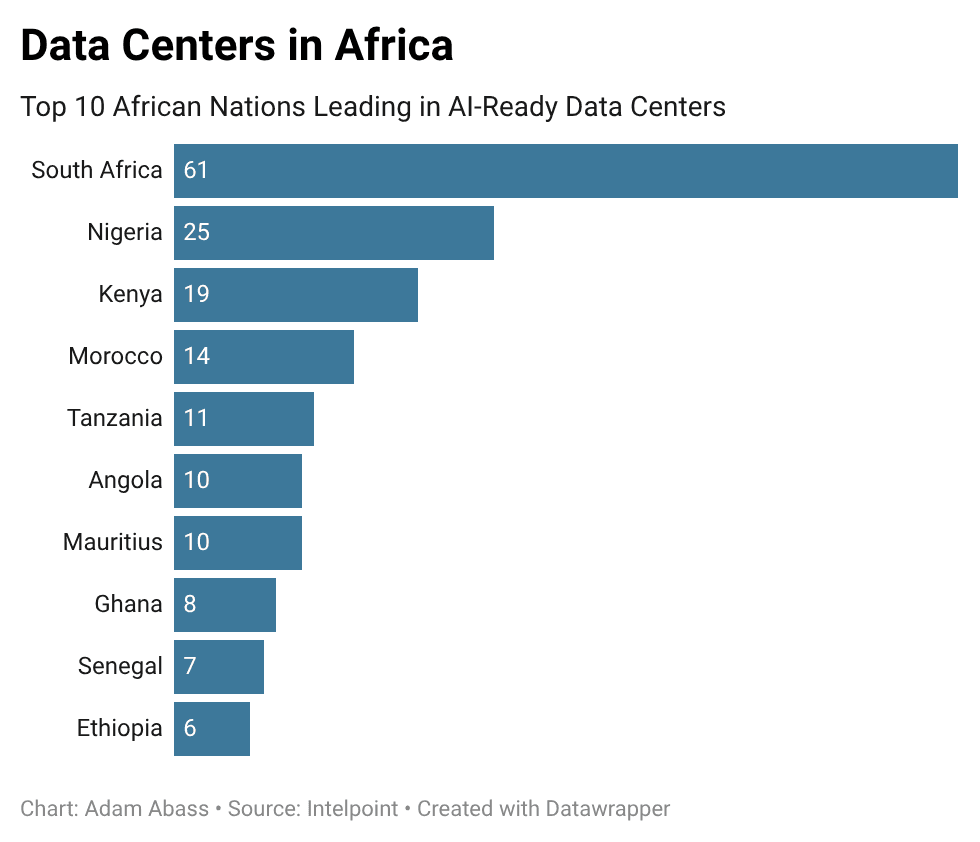
To overcome these barriers, African governments will need to invest heavily in developing local talent through specialised AI research and training centres. Similar investment is required in commercial data centre infrastructure to support AI development and deployment. The continent currently hosts only about 200–270 data centres, the majority of which are located in Nigeria, Kenya, and Egypt. Finally, African governments must strengthen AI governance and oversight frameworks that are tailored to the continent's unique security and technological landscape.
Artificial Intelligence is no longer a future capability but an increasingly central component of modern military power. African militaries have begun integrating AI into surveillance, logistics and border security, but adoption remains uneven and largely tactical. The continent's evolving security environment demands broader investment in AI-enabled intelligence, command systems and decision-support capabilities if military institutions are to keep pace with increasingly adaptive armed groups.
Whether that transition occurs will depend less on acquiring advanced technologies than on building the institutional foundations that sustain them. Investment in digital infrastructure, specialised talent, defence research, and governance frameworks will ultimately determine whether AI becomes a force multiplier for African security or another capability imported from abroad and only partially integrated into military operations.
Adam Abass
Adam Abass is a graduate student of political science and international relations. His research focuses on Middle Eastern politics, counter-terrorism, peace, and security in Africa.
comments
No comments yet