
The Terror Next Door: What the Recent School Abduction Reveals About Southwest Nigeria’s Security Collapse
by

When Nigeria Happens to Children: What Does It Mean?
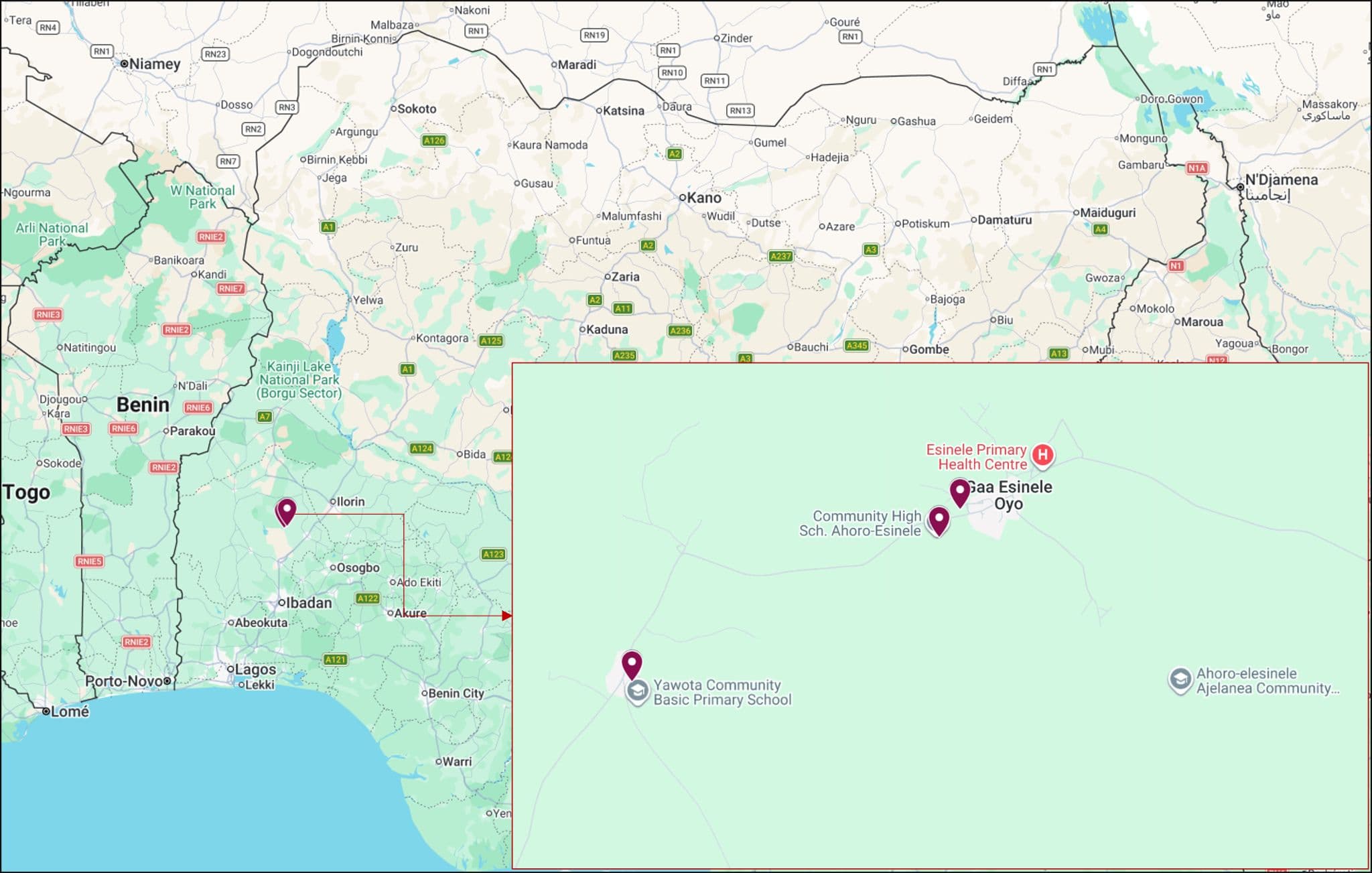
On Friday, May 16, 2026, children in Oriire Local Government Area of Oyo State had just finished morning assembly and settled into the familiar rhythms of classroom life. By 9:30 a.m., armed men in large numbers stormed three schools in the Ahoro-Esiele/Yawota axis of Ogbomoso, Baptist Nursery and Primary School, Yawota; Community Grammar School, Esiele; and L.A. Primary School, and the school day was over in the worst possible way.
By the time the guns fell silent, at least two people were dead, among them an assistant headmaster, and dozens of children and teachers had been marched at gunpoint into the forests bordering the Old Oyo National Park.
Oyo State Governor, Engineer Oluwaseyi Makinde, later confirmed that seven students had been abducted from Community Grammar School and 18 pupils, along with seven teachers from First Baptist Nursery and Primary School, making a total of at least 32 confirmed victims, with some reports putting the figure as high as 45 to 48. According to the State Governor:
Now we can confirm conclusively that at the Community Secondary School, about seven students were abducted, while at the First Baptist Primary and Nursery School, 18 children were abducted, and about seven teachers were also involved. And unfortunately, like I reported yesterday, one of them was killed.’
For many Nigerians watching from outside the region, the sheer scale of the attack was shocking. For those who had been sounding the alarm about the southwestern states for years, it was a justification of their worries. It was the bill finally coming due.
For decades, Nigeria’s Southwest maintained a reputation, partly earned, partly assumed, as a zone of relative stability. While other regions grappled with insurgency and large-scale banditry, Yorubaland in the national political imagination and in the minds of its own people was different, more urbanised, more organised, and more protected by a relatively stronger civil culture, denser infrastructure, and a history of political engagement that other regions did not enjoy.
The forests bordering the Old Oyo National Park, where the abducted children and teachers were marched, are not unfamiliar terrain to security analysts. For years, they have been flagged as one of the most dangerous blind spots in the Southwest's security architecture.
By July 2025, community leaders in Igbeti and Igboho in Olorunsogo and Orelope Local Government Areas of Oyo State were already raising alarm that the Old Oyo National Park had become a functioning hideout for bandits and kidnappers. The warnings went largely unheeded at the scale they deserved. Then, on January 6, 2026, armed bandits arrived on motorcycles at the National Park Service office in Oloka village and launched a deadly assault, killing five forest guards. Investigations later reveal that the attackers' primary goal was to free their colleagues already held in custody by forest rangers.
A Pattern That Will Not Stay Put
The trajectory of kidnapping in Southwest Nigeria is neither random nor sudden. It follows a discernible pattern of expansion. Highways were the first pressure points. The Lagos-Ibadan Expressway, the Akure-Ado Ekiti Road, and the Ogbomoso-Iseyin axis have, over time, shifted from transit corridors to zones of calculated risk. Abductions along these routes established both the feasibility and profitability of kidnapping operations in the region.
From there, the geography widened. Farming communities, particularly in Ondo and Oyo, became targets, with armed groups exploiting forest cover to establish operational bases. According to a report by The Guardian Nigeria, by 2025, over 40 percent of farmlands across parts of the Southwest were under threat from insecurity, forcing many farmers to abandon cultivation.
The report detailed how armed herders attacked farming settlements in the Akure North Local Government Area of Ondo State, killing about 21 farmers and destroying camps, including Aba Sunday, Aba Pastor, Ademekun Camp, and Aba Alajido. Days later, another attack in Aba Oyinbo reportedly left five farmers dead, while a separate January assault in the Ajegunle-Powerline community also claimed five lives. Beyond Ondo, farmers in Osun State recounted repeated invasions of cassava and plantain farms by herders, leading to losses worth millions of naira.
In January 2024, Ekiti State witnessed a killing that carried both symbolic and practical implications. Two traditional rulers, Oba Olatunde Samuel Olusola and Oba David Babatunde Ogunsola, were murdered while returning from a security meeting convened to address the very threat that claimed their lives. That same month, also in Ekiti, gunmen invaded Apostolic Faith Nursery and Primary School in Emure-Ekiti, abducting six pupils, three teachers, and a driver.
To understand what happened in Oriire, you have to understand what Nigeria has been living through since April 2014, when Boko Haram took 276 schoolgirls from Chibok in Borno State, and the world briefly paid attention. The abductions did not stop when the attention did. In 2018, 110 girls were taken from the Government Girls Science and Technical College in Dapchi, Yobe State. In December 2020, over 344 boys were seized from their dormitories in Kankara, Katsina State.
The following year brought fresh horrors in Kagara, Niger State, and Jangebe, Zamfara State, before gunmen raided Bethel Baptist High School in Kaduna and took more than 100 students in July 2021. March 2024 saw 287 pupils abducted from a school in Kuriga, Kaduna State, who were marched for hundreds of kilometers through the bush with little food or water.
By November 2025, the scale had grown still larger, 25 girls were taken from a boarding school in Kebbi State, and just three days later, 303 children and 12 teachers were seized from St. Mary's Catholic School in Papiri, Niger State, the single largest school abduction in Nigerian history.
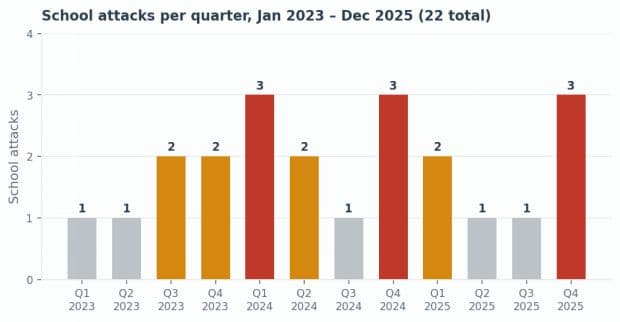
The Institute for Security Studies (ISS) calculated that between January 2023 and late 2025 alone, at least 816 pupils were taken in 22 separate attacks on schools across the country. Each incident produced the same sequence: shock, condemnation, a government press conference, a security operation, and then, eventually, silence until the next school fell.
Ransom: The Economics Driving the Crisis
For families across Nigeria, kidnapping is no longer a distant horror. It is a financial catastrophe waiting to happen. And when it does happen, the first question, after the initial terror subsides, is almost always, "Where will we find the money?"
The International Centre for Investigative Reporting (ICIR) reported that the National Bureau of Statistics, in its Crime Experience and Security Perception Survey 2024, disclosed that Nigerians paid N2.23 trillion to kidnappers as ransoms in just 12 months, between May 2023 and April 2024. That figure, if taken at face value, means the ransom subsector of the Nigerian economy rivals what the federal government spends on the entire 2024 allocation to the health sector, and education sector.
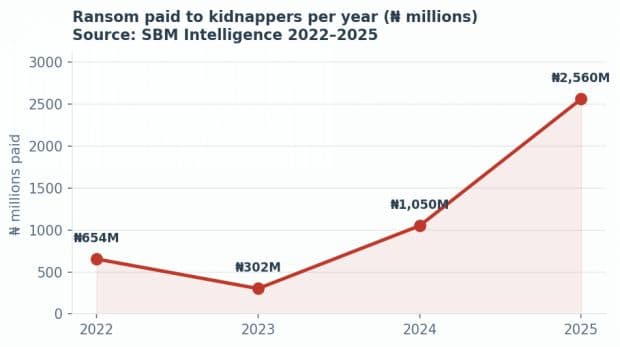
Even taking a more conservative estimate from the SBM Intelligence research firm, published in August 2025, the rate is alarming. Between July 2024 and June 2025, at least 4,722 people were abducted in 997 separate incidents nationwide, with kidnappers demanding N48 billion in ransoms. Of that, N2.56 billion was actually paid, and one single case, the abduction of a High Court judge in Borno State, accounted for nearly N766 million of that total.
Loophole in Security Infrastructure
What the Oriire attack exposes, perhaps more starkly than any recent incident in the Southwest, is the extent to which Nigeria’s security architecture remains reactive, fragmented, and, in many cases, absent at the point of need.
Across much of rural Oyo, as in neighbouring states, formal policing presence is thin to the point of invisibility. Schools, particularly public primary and secondary institutions, operate without perimeter security, trained guards, or a rapid-response protocol to activate in the event of an attack. In Oriire, the distance between the schools and the nearest effective security formation created a vacuum that armed men were able to exploit with precision. With the Ikoyi-Ile Divisional Police Station located roughly 36 to 43 kilometers away, making a rapid response was virtually impossible.
Between 2020 and 2025, federal allocations to the Ministry of Police Affairs more than tripled, rising from approximately N409 billion to over N1.31 trillion. And yet, by late 2025, the country's police workforce stood at between 370,000 and 371,800 officers for a population of over 220 million. To meet the global benchmark of 311 officers per 100,000 people, Nigeria would need approximately 684,200 officers, meaning it is operating with a shortfall of over 310,000 personnel. No state in the Southwest has escaped the consequences of that arithmetic.
When the abductors fled into the forests bordering the Old Oyo National Park, it was Amotekun operatives who were among the first responders entering those corridors alongside soldiers, police, and local vigilantes. According to Governor Makinde, the rescue teams encountered improvised explosive devices planted by the terrorists. One Amotekun operative was left in critical condition in the hospital, while several soldiers, hunters, and other security personnel were wounded. Separately, soldiers, Amotekun Corps members, and local vigilantes lost their lives when they ran into IEDs planted by the abductors during rescue operations.
Men walking into a forest with dane guns and pump-action rifles to track a group planting explosives is not a tactical deployment.
The performance of the security agents, Amotekun Corps and local vigilantes, is not a failure of the outfit itself but a failure of the political framework within which it has been constrained to operate. The question of whether to properly authorise and arm Amotekun is not, at this point, a theoretical debate about constitutional federalism. It is a question about whether the men and women being sent into those forests have any realistic prospect of coming out alive, let alone of rescuing anyone.
What Must Now Be Said
The sustained military pressure on banditry and insurgency in Nigeria's Northwest and North-Central has not eliminated armed groups. It has displaced them. And displacement, in the Nigerian geography, points south toward forests, toward less-watched corridors, and toward communities that have not yet developed the reflexes of survival that northern villages have been forced to acquire.
By Thursday of that same week, the Defence Headquarters confirmed that the terrorists responsible for the Oriire kidnapping were members of Jama'atu Ahlis Sunna Lidda'awati wal-Jihad (JAS), who had been dislodged from other parts of the country by sustained military operations.
The argument that the Southwest is not permanently infiltrated is technically defensible. The argument that it is therefore not urgently at risk is not. A group that can plan a simultaneous three-school abduction, plant IEDs along forest escape routes, communicate in Yoruba, Hausa, and Pidgin, use the children as human shields, behead a teacher on camera to demonstrate resolve, and then open direct negotiations with a state government is not probing the edges of the system.
A regional breakdown of kidnapping figures published by SBM Intelligence for the period between July 2024 and June 2025 showed the Northwest accounting for 425 incidents and 2,938 abductions, the Southeast recording 257 victims, and the Southwest recording 144. Those Southwest numbers, relatively modest in the national context, mask a trajectory that is moving in one direction only.
The forest corridor connecting northern Kwara, Niger, and Kebbi states to Oyo's northern local government areas is not a metaphor. It is a road.
The children who were marched into the forests of Oriire on the morning of May 16, 2026, were not victims of the unknown. They were victims of the unacted upon. As far back as January 2026, armed bandits had attacked forest guards inside the Old Oyo National Park. Community leaders in Igbeti and Igboho had been raising alarms since July 2025. The corridors JAS used to enter, operate, and escape had been flagged long before they became an escape route. That the attack was seamless was not a function of JAS's sophistication alone, it was a function of the complete absence of any coordinated plan to deny them the terrain, the time, and the impunity they needed to succeed.
Àkànní Olúwaségún Michael
Àkànní Olúwaségún Michael is a freelance journalist based in Nigeria and a student of Communication and Language Arts. He reports on migration, governance, security, development, and other underreported issues affecting African communities. His work centers on human-centered storytelling and public-interest journalism, with a focus on bringing local stories to global audiences through in-depth reporting and research
comments
Ajibola Joseph Olasubomi
13w
Insightful and informative. Pointing out the important things in insugecy.